Festive Campaign Marketing in India: A Complete Guide for Businesses
India's festive season creates opportunities for businesses to reconnect with existing customers, attract new buyers, promote special offers and increase sales. From Ganesh Chaturthi and Navratri to Diwali, Eid, Christmas, Pongal, Onam and Baisakhi, festivals influence shopping habits, local events, travel, dining and purchasing decisions across different parts of the country.
However, successful festive marketing involves more than sending a greeting or announcing a discount. Businesses need to reach the right audience, choose suitable communication channels, communicate their offers clearly and follow up at the right time.
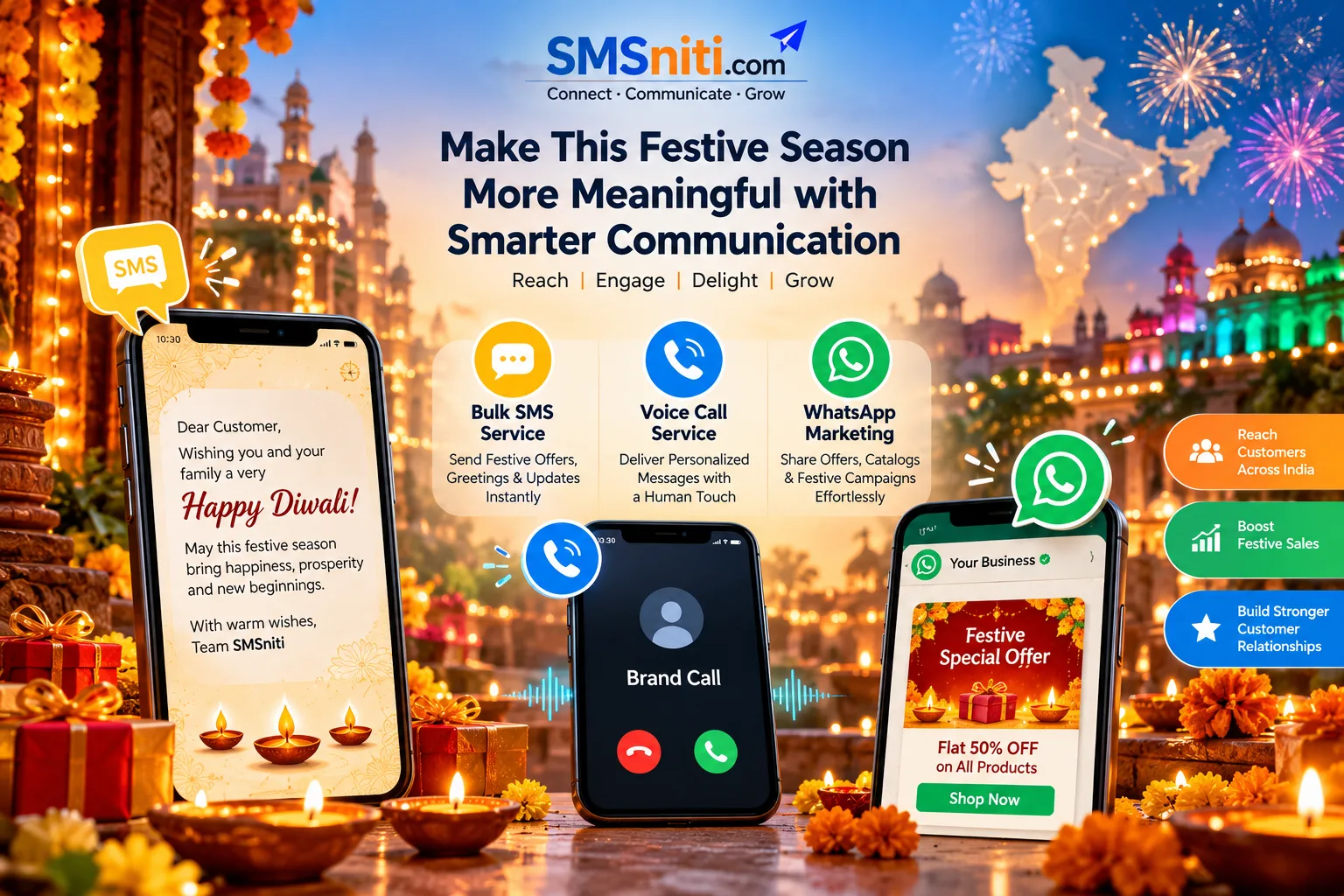
A well-planned festive campaign can combine bulk SMS, voice call campaigns and WhatsApp marketing to create a consistent customer experience across multiple touchpoints. For example, a retail store might send an SMS announcing a festive sale, share its catalogue through WhatsApp with customers who have opted in, and use a permitted automated voice call campaign to communicate important offer details to an eligible audience.
The advantage of this approach is flexibility. A local jewellery showroom, an educational institution, a real estate developer, a restaurant chain and an e-commerce business do not need the same campaign. Each can adapt its message, language, offer and communication channel to its audience.
SMSNiti helps businesses explore communication solutions such as bulk SMS, bulk voice calls and WhatsApp marketing for customer outreach and promotional campaigns. Businesses can use these channels individually or combine them into a coordinated festive marketing strategy.
This guide explains how to plan festival campaigns across India, choose the right communication channel, create regional marketing messages, improve customer engagement and measure campaign performance.
What Is Festive Campaign Marketing?
Festive campaign marketing is a planned promotional activity built around a festival, seasonal occasion or culturally significant event. It uses relevant offers, messages, content and customer communication to encourage awareness, engagement, enquiries, visits or purchases.
Unlike a routine promotional campaign, festive marketing connects a business's message with an occasion that matters to its target audience.
Examples include:
A jewellery retailer promoting a festive collection before Diwali.
A restaurant sharing special festive menus with its opted-in customers.
A coaching institute announcing admissions during a regional holiday period.
A real estate company inviting prospects to a festive property exhibition.
A clothing store promoting regional collections during Onam, Pongal or Durga Puja.
A local electronics retailer announcing limited-period festive discounts.
An event organiser sharing registration details for a community celebration.
An effective campaign has a defined audience, a clear objective, a relevant offer, a suitable communication channel and a measurable outcome.
Why Festive Marketing Matters for Indian Businesses
India does not have a single, uniform festive shopping calendar. Different regions, communities and customer groups celebrate different occasions, often with distinct purchasing priorities.
This creates opportunities for businesses to run more relevant campaigns throughout the year rather than concentrating all their marketing activity around Diwali.
1. Reach customers when your offer is relevant
A festive promotion gives customers a clear reason to consider a purchase, visit a store, attend an event or enquire about a service.
The key is relevance. A restaurant can promote a festive dining experience, while a real estate company might invite interested buyers to a property showcase. Both campaigns use the same seasonal opportunity but communicate different benefits.
2. Reconnect with existing customers
Festivals provide a natural reason to contact previous buyers, loyal customers and people who have previously shown interest in a product or service.
A personalised message can highlight a new collection, an exclusive offer or a relevant seasonal service. Businesses should use appropriate contact permissions and customer preferences when planning promotional outreach.
3. Generate enquiries and store visits
Not every festive campaign needs to focus on immediate online sales. Local businesses can use campaigns to generate phone enquiries, WhatsApp conversations, appointment bookings, showroom visits and event registrations.
A campaign should make the next action easy. Include a relevant landing page, booking link, contact number or permitted response mechanism.
4. Reach customers in different Indian regions
Regional relevance can improve the usefulness of a campaign. A business serving customers in Maharashtra may plan around Ganesh Chaturthi and Gudi Padwa, while a business in Kerala may give greater attention to Onam and Vishu.
Businesses serving multiple states can maintain a common brand identity while adapting messages to local occasions, languages and customer interests.
5. Coordinate communication across channels
Customers may encounter a business through several communication channels before making a decision.
An SMS can deliver a concise offer, WhatsApp can provide additional product information, and a voice call can communicate a short announcement to an appropriate audience.
The purpose is not to contact customers repeatedly through every channel. It is to choose the channel that best serves each stage of the campaign.
The Major Types of Festive Marketing Campaigns
Before selecting a communication channel, decide what the campaign needs to accomplish.
Festive sales and discount campaigns
These campaigns announce special prices, product bundles, seasonal collections, limited-period offers or loyalty benefits.
Suitable businesses: Retail stores, jewellery brands, electronics dealers, fashion retailers, supermarkets and e-commerce businesses.
Example: A clothing retailer announces its festive collection two weeks before a major festival, shares selected products with interested customers and sends a final reminder before the offer ends.
Festive lead-generation campaigns
Lead-generation campaigns encourage prospects to enquire, request a quotation, register for an event or book a consultation.
Suitable businesses: Real estate companies, educational institutions, financial service providers and event organisers.
Example: A property developer invites interested prospects to a festive property exhibition and provides a clear appointment-booking option.
Customer appreciation campaigns
These campaigns focus on maintaining relationships rather than making an immediate sale.
Businesses can send festive greetings, thank customers for their continued support and share relevant updates. Promotional content should be clearly distinguished from a simple greeting where applicable.
Festive event promotion
Event organisers can promote cultural programmes, exhibitions, local fairs, concerts, community events and festive experiences.
SMS can communicate essential event details, while WhatsApp can share posters, registration information and updates with opted-in recipients.
Seasonal service campaigns
Some businesses have seasonal demand that goes beyond shopping.
Examples include travel bookings, hotel reservations, restaurant packages, home cleaning, interior decoration, gifting, catering and event services.
The strongest campaign connects a specific seasonal need with a clear service benefit.
How to Use Bulk SMS for Festive Marketing
SMS is useful when a business needs to communicate a concise message with an offer, deadline, event detail or action link.
A well-written festive SMS should make the sender recognisable, explain the benefit and tell the recipient what to do next.
When should businesses use SMS?
Bulk SMS can support campaigns such as:
Festive sale announcements.
New product and collection launches.
Special offer reminders.
Store opening and event announcements.
Registration and appointment information.
Order-related updates where appropriate.
Campaign follow-ups for eligible recipients.
For example, a retailer might send an early announcement to interested customers, followed by a reminder shortly before an offer expires. The messages should provide new value rather than simply repeating the same promotion.
How to write a festive SMS
Keep the message focused on one offer or action. Avoid unnecessary words, unclear discounts and multiple competing links.
Example: Retail festive offer
“Celebrate the festive season with special offers on selected styles at [Store Name]. Explore the collection: [Link]. Terms apply.”
Example: Restaurant promotion
“Make your festive celebrations special with our seasonal menu at [Restaurant Name]. View the menu and reserve your table: [Link].”
Example: Educational institution
“Admissions are open for the upcoming academic session at [Institute Name]. Explore programmes and request details: [Link].”
These examples are starting points, not ready-to-send registered templates. Businesses should ensure that promotional SMS content, sender registration, consent requirements and other applicable telecom rules are satisfied before sending campaigns.
Why SMS can complement other festive channels
SMS is particularly useful for short messages that need to communicate one clear point. It can complement a richer WhatsApp interaction or a permitted voice call campaign without requiring every message to contain extensive product information.
Explore SMSNiti's bulk SMS solutions to understand the available communication options for business campaigns.
How Voice Call Campaigns Can Support Festive Promotions
Some promotions benefit from a spoken announcement, especially when the business needs to communicate an event, explain a simple offer or reach an eligible audience that may prefer audio over a text-heavy message.
A voice call service can support festive marketing through automated recorded announcements or other supported voice campaign formats, depending on the service and applicable requirements.
For businesses planning voice call marketing for festive offers, the important consideration is the message itself: it should be brief, understandable, relevant and easy to act upon.
When are festive voice call campaigns useful?
1. Local retail announcements
A retailer can communicate the opening of a festive sale, the availability of a new collection or an invitation to visit a showroom.
2. Event and exhibition invitations
Businesses organising festive exhibitions, product demonstrations or community events can use an appropriate voice announcement to communicate the event date and registration details.
3. Regional-language campaigns
A spoken message in a language familiar to the intended audience may make an announcement easier to understand. The language should match the audience rather than relying on a single recording for every region.
4. Short campaign reminders
A permitted voice campaign can remind an eligible audience about an approaching event or a clearly defined offer deadline.
5. Local business promotions
Retailers, restaurants and service providers can consider voice campaigns when a concise spoken announcement fits their audience and campaign objective.
How to plan an effective festive voice call
Start by defining the audience and the purpose of the call. Then write a script that sounds natural when spoken aloud.
A practical script structure is:
Identify the business clearly.
State the purpose of the call.
Explain the main offer or event.
Mention the relevant date or deadline.
Provide one clear next step.
Example voice call script for a festive retail offer
“Namaste! This is [Store Name]. We are celebrating the festive season with special offers on selected products until [Date]. Visit our store at [Location] or explore the details at [Website]. Thank you, and we wish you a wonderful festive season.”
The final script should be reviewed for pronunciation, pacing, language accuracy and clarity before deployment.
Businesses should also review applicable consent, recipient preference, registration and calling-time requirements. Promotional voice calls must not be treated as a way to bypass customer preferences or telecom regulations.
Learn more about voice call marketing for festive offers through SMSNiti.
How WhatsApp Marketing Can Improve Festive Campaigns
WhatsApp can support campaigns that need more context than a short text message can provide. Depending on the format and approved functionality available, businesses may use it to share product catalogues, festive posters, offer details, event information and customer support conversations.
WhatsApp works best when the message is relevant to the recipient and gives them a useful reason to engage.
What can businesses promote through WhatsApp?
Festive product catalogues.
Seasonal collections and product launches.
Restaurant menus and event packages.
Festival-specific gift hampers.
Event registration and booking details.
Customer service and sales enquiries.
Relevant updates for opted-in customers.
Example: A festive WhatsApp campaign
Imagine a jewellery retailer preparing for Diwali.
The business could announce its festive collection to customers who have opted in to receive updates. It could then share selected products and appointment information with interested customers. Customers who respond can continue the conversation with the sales team.
The objective is to create a useful customer journey rather than send repeated promotional messages without considering customer interest.
How to make WhatsApp campaigns more effective
Use relevant creative assets. A clear product photograph, readable festive design or concise catalogue can help customers understand the offer.
Segment customers. Group customers by relevant factors such as product interest, previous purchases, location or stated preferences where appropriate.
Personalise the message responsibly. Use accurate information and avoid personalisation that feels intrusive or relies on data the customer has not agreed to share.
Use the correct messaging setup. Businesses should follow WhatsApp's current business messaging policies, consent expectations and applicable template or platform requirements.
Make responses manageable. If a campaign generates enquiries, ensure someone can answer questions about pricing, availability, bookings and delivery.
Explore SMSNiti's WhatsApp marketing service for business messaging options.
SMS vs Voice Calls vs WhatsApp: Which Channel Is Best for Festive Marketing?
There is no single best channel for every festive campaign. The right choice depends on the audience, the message, the desired action, available budget and the business's ability to respond to customers.
Campaign requirementSuitable channelWhy it may fitShort sale announcementSMSCommunicates a concise offer and linkProduct catalogue or festive posterWhatsAppSupports richer visual informationSpoken event invitationVoice callDelivers the message in audio formAppointment or enquiry generationWhatsApp or SMSProvides a route to respond or bookSimple deadline reminderSMS or an appropriate voice campaignKeeps the message focusedCustomer conversationWhatsAppSupports two-way interactionRegional-language announcementSMS, WhatsApp or voiceCan be adapted to the audience and format
These are practical starting points, not universal performance rankings. Campaign results depend on message quality, recipient relevance, permissions, delivery conditions and the offer itself.
Should businesses use all three channels together?
They can, provided every channel has a clear purpose.
Consider a festive campaign for an electronics retailer:
Stage 1 — Awareness: Send a concise announcement to eligible customers.
Stage 2 — Product discovery: Share relevant product information with interested WhatsApp recipients.
Stage 3 — Reminder: Use a suitable, permitted reminder for customers who have opted in to the relevant communication.
Stage 4 — Measurement: Compare enquiries, visits, sales and campaign costs.
This approach avoids treating SMS, voice calls and WhatsApp as interchangeable tools. Each channel contributes something different to the customer journey.
India's Regional Festival Calendar: Plan Beyond Diwali
A national festive marketing strategy should reflect India's regional diversity. The following table provides planning examples; actual festival dates change by year and may vary by local calendar or observance.
Festival or occasionImportant regions or audiencesCampaign ideasMakar Sankranti and PongalMaharashtra, Gujarat, Karnataka, Telangana, Andhra Pradesh and Tamil Nadu, with local variationsSeasonal products, gifting and regional collectionsVasant PanchamiSeveral northern, eastern and other parts of IndiaEducation, cultural events and seasonal promotionsMaha ShivaratriAcross India, with local observancesRelevant event information and seasonal offeringsHoliNorth India and many other regionsFashion, gifting, food and event promotionsGudi Padwa and UgadiMaharashtra, Karnataka, Andhra Pradesh and TelanganaNew-year offers, jewellery, home products and retail campaignsBaisakhiPunjab and parts of North IndiaFashion, food, community events and local retailEid al-Fitr and Eid al-AdhaAcross India, with regional and community variationClothing, gifting, food and relevant seasonal servicesRath YatraEspecially Odisha, with other local observancesEvent information and relevant local promotionsOnamKerala and Malayali communities elsewhereApparel, gifting, food, hospitality and retailGanesh ChaturthiEspecially Maharashtra, with celebrations elsewhereLocal retail, event announcements and seasonal productsNavratri and Durga PujaGujarat, West Bengal, Maharashtra and other regionsFashion, jewellery, event bookings and local promotionsDussehraAcross India, with regional differencesRetail offers, product launches and seasonal servicesDiwaliAcross IndiaGifting, jewellery, electronics, fashion and home productsChristmas and New YearAcross India, with local audience differencesHospitality, travel, gifting, dining and events
Businesses should confirm the relevant dates for each year's campaign calendar before scheduling messages.
North India: Build campaigns around local relevance
Businesses serving Delhi, Uttar Pradesh, Punjab, Haryana, Rajasthan and neighbouring markets can plan around occasions such as Holi, Raksha Bandhan, Navratri, Dussehra and Diwali, while accounting for differences between states and communities.
Campaigns can feature seasonal clothing, home decoration, gifting, jewellery, retail promotions and event invitations. Hindi may be suitable for some audiences, while Punjabi, Rajasthani or other local-language adaptations may be more relevant in particular markets.
West India: Connect with regional celebrations
Maharashtra, Gujarat and Goa offer opportunities around festivals such as Ganesh Chaturthi, Gudi Padwa, Navratri, Dussehra and Diwali, alongside other local celebrations.
Businesses can tailor their promotions to regional shopping preferences and event calendars. For example, a retailer might create Marathi-language campaign variants for selected Maharashtra audiences and Gujarati-language variants for relevant Gujarat audiences.
South India: Plan for distinct festive calendars
Tamil Nadu, Kerala, Karnataka, Andhra Pradesh and Telangana have different combinations of cultural and seasonal occasions.
Pongal, Onam, Ugadi, Vishu, regional New Year celebrations and other local festivals can provide opportunities for hospitality, retail, gifting, food and education campaigns.
A business serving several southern states should avoid assuming that a single regional-language message or festival promotion will suit every audience.
East and Northeast India: Account for regional observances
West Bengal, Odisha, Assam and the northeastern states have diverse cultural calendars and local preferences.
Durga Puja, Rath Yatra, Bihu and other regional observances may be relevant to particular audiences. Campaigns should be adapted to the specific state, community and business context rather than grouping the entire region under one message.
Central India and multi-state campaigns
Businesses serving Madhya Pradesh, Chhattisgarh and customers across multiple states can combine nationally relevant occasions with state-specific campaigns.
The practical approach is to create a common campaign framework and then customise the festival, language, offer and creative assets for each target market.
How to Create Regional-Language Festive Campaigns
Language localisation is more than translating a sentence word for word. The message should sound natural, communicate the offer accurately and reflect the occasion appropriately.
Follow these steps when preparing a multilingual campaign.
Step 1: Identify the audience's preferred language. Use reliable, appropriately collected customer preferences or campaign-level audience information.
Step 2: Adapt the message. Have a fluent reviewer check the language, spelling, cultural context and tone.
Step 3: Keep the offer consistent. Prices, eligibility, dates, exclusions and terms should remain accurate across language versions.
Step 4: Test the complete message. Review text rendering, links, voice pronunciation, images and the customer response process.
Step 5: Compare results by audience. Measure delivery, engagement, enquiries and conversions across regions without assuming that language alone explains the difference.
For voice campaigns, pronunciation matters especially. A poorly pronounced local name or awkwardly translated offer can reduce clarity even when the underlying promotion is attractive.
How to Plan a Festive Campaign Step by Step
A structured process helps businesses prepare campaigns in advance and avoid rushed communication during peak festival periods.
Step 1: Define the business objective
Choose one primary objective for each campaign: awareness, enquiries, store visits, bookings, sales or repeat purchases.
A campaign designed to generate property enquiries should not be evaluated using the same criteria as a campaign designed to increase retail transactions.
Step 2: Select the festival and audience
Identify the relevant festival, target geography, audience segment and customer need.
For a national campaign, divide the audience into practical regional or interest-based groups rather than treating every customer as identical.
Step 3: Develop the offer
Decide what the customer receives and why the offer is relevant.
Examples include a seasonal product collection, an event invitation, a bundle, a booking opportunity or a clearly defined discount. Avoid vague claims that customers cannot verify.
Step 4: Choose the communication channels
Decide whether SMS, WhatsApp, voice calls or a combination best serves the objective.
A short announcement may require only SMS. A catalogue-led promotion may be better suited to WhatsApp. A spoken invitation may suit an appropriate voice campaign.
Step 5: Prepare the creative and copy
Write channel-specific messages rather than copying identical content into every format.
SMS should remain concise. WhatsApp creative should make the offer easy to understand. Voice scripts should sound natural when spoken.
Step 6: Verify permissions and compliance
Before launching, check recipient consent, communication preferences, applicable registration requirements, approved templates, platform policies and any relevant restrictions.
Step 7: Test before scaling
Review the sender identity, message content, links, landing page, language variants, voice recording and response workflow.
Where practical, run a controlled test with an appropriate audience before deploying a larger campaign.
Step 8: Launch at the right stage
Plan the campaign around customer decision-making rather than choosing dates arbitrarily.
A retail campaign might start with an announcement, move into product discovery and finish with a timely reminder. The ideal timing will differ by product category, festival and customer purchase cycle.
Step 9: Measure and improve
Compare campaign results against the original objective. Identify which audiences, messages and channels contributed to meaningful outcomes.
Use those findings to improve the next festival campaign rather than repeating the same approach automatically.
A Practical 30-Day Festive Campaign Timeline
The following timeline is a flexible planning example for a campaign where customers need time to discover an offer and make a purchase.
PeriodMain activitySuggested communicationDays 1–7Audience preparation, offer planning and creative developmentSegment customers, validate consent and prepare channel-specific messagesDays 8–14Initial campaign launchAnnounce the offer through the most relevant channelDays 15–21Product discovery and engagementShare relevant details, answer enquiries and support interested customersDays 22–27Conversion periodCommunicate important deadlines or booking details to eligible recipientsDays 28–30Campaign reviewMeasure results, document lessons and plan follow-up
Not every festival requires a 30-day campaign. A local event might need a shorter window, while an expensive purchase may require a longer consideration period.
The important principle is to plan the entire customer journey, not simply the first message.
How to Measure Festive Marketing Campaign Performance
A campaign is only as useful as the outcomes it helps a business understand.
The right metrics depend on the objective and the reporting capabilities available for each channel.
Delivery and reach
Track submitted messages, delivery reports where available, eligible audience size and other channel-specific delivery indicators.
Delivery does not automatically mean that a customer read, heard or acted on the message.
Engagement
Depending on the channel, engagement can include link clicks, replies, calls, enquiries, registrations and other measurable actions.
Use consistent tracking links and campaign identifiers wherever possible.
Leads and conversions
Track the number of qualified enquiries, appointments, bookings, purchases or other actions that matter to the business.
Where possible, connect campaign data with a CRM or sales reporting system to understand what happens after the initial interaction.
Cost per result
Calculate campaign costs against the chosen outcome.
For example:
Cost per lead = Total campaign cost ÷ Number of qualified leads generated
If a campaign costs ₹12,000 and generates 120 qualified leads, the cost per lead is ₹100. This is an illustrative calculation, not a claim about typical campaign performance.
Return on campaign investment
Businesses with reliable revenue and cost data can calculate a campaign return using a clearly defined method.
One common approach is:
Marketing ROI = (Incremental profit attributable to the campaign − Marketing cost) ÷ Marketing cost × 100
The calculation is only meaningful when the profit estimate and attribution method are credible. Revenue alone should not be confused with profit, and seasonal demand may have contributed to sales independently of the campaign.
Common Festive Marketing Mistakes to Avoid
Even a well-funded campaign can underperform when the message, audience or follow-up process is poorly planned.
Sending the same message to every customer
A first-time prospect, a loyal customer and someone who purchased a specific product may have different interests.
Segment audiences where appropriate and send relevant messages rather than assuming every customer needs the same offer.
Starting too late
Launching only on the festival day can leave little time for customers to compare products, ask questions or arrange purchases.
Start early enough for the type of purchase involved, then use appropriate reminders where they add value.
Using a single language across every region
A national campaign should not automatically use one language for every audience. Localise messages where the customer base and business objective justify it.
Overusing communication channels
Sending SMS, WhatsApp messages and calls to the same person in quick succession can become intrusive.
Create a communication plan that limits unnecessary repetition and respects customer preferences.
Making unclear or misleading claims
Terms such as “biggest discount,” “guaranteed savings” or “last chance” should be used only when they are accurate and supportable.
Clearly explain offer eligibility, validity and relevant conditions.
Ignoring the next step
A campaign can attract attention but still fail to generate results if the customer cannot find the product, contact the business or complete a booking.
Make the next action clear and ensure the destination works properly on mobile devices.
Failing to measure outcomes
Without campaign tracking, it becomes difficult to determine whether a channel, audience segment or offer contributed to the desired result.
Set measurement criteria before launching the campaign.
TRAI and Messaging Compliance: What Businesses in India Should Know
Promotional communication in India must be planned with applicable telecom and platform requirements in mind.
According to the Telecom Regulatory Authority of India's guidance for senders, businesses sending commercial communications through regulated telecom channels may need to complete applicable Principal Entity registration, header and content-template registration, and consent-related requirements.
The specific obligations depend on the communication type and applicable rules. Businesses should verify the current requirements with their telecom service provider and authorised partners before launching promotional SMS or voice campaigns.
For WhatsApp campaigns, businesses should also follow the applicable WhatsApp Business policies, consent expectations and approved messaging requirements.
A practical compliance checklist includes:
Confirm that the audience is eligible to receive the communication.
Obtain and maintain consent where required.
Verify the relevant sender registrations and approved templates.
Respect opt-outs and customer communication preferences.
Check calling and messaging restrictions before scheduling campaigns.
Keep promotional claims accurate and offer terms clear.
Review current platform rules before sending WhatsApp messages.
Campaign reach should never come at the expense of customer trust or compliance.
How SMSNiti Can Support Festive Marketing Campaigns
Businesses planning seasonal promotions may need more than one communication format. The right combination depends on the campaign objective, audience, message and available budget.
SMSNiti offers business communication options that include bulk SMS, bulk voice calls, WhatsApp marketing and WhatsApp API services.
These options can support different parts of a festive marketing plan.
Bulk SMS: Useful for concise announcements, offer details and relevant campaign links.
Bulk voice calls: Suitable for brief spoken announcements and eligible promotional outreach where the format and applicable requirements permit.
WhatsApp marketing: Useful for relevant product information, campaign creatives and customer conversations with recipients who have opted in.
WhatsApp API: Worth exploring for businesses that need supported business messaging integrations and structured communication workflows.
The best starting point is to identify the business outcome, the intended audience and the communication format that makes the most sense. Businesses can then assess the relevant SMSNiti service, expected costs, operational requirements and reporting options before launching.
To explore the available services, visit SMSNiti or review its bulk voice call service and WhatsApp marketing service.
Frequently Asked Questions About Festive Campaign Marketing
1. What is festive campaign marketing?
Festive campaign marketing is a promotional strategy built around festivals and seasonal occasions. It can use SMS, voice calls, WhatsApp, advertising and other channels to generate awareness, enquiries, visits or sales.
2. Which communication channel is best for festive marketing in India?
The best channel depends on the audience and objective. SMS is useful for concise messages, WhatsApp can support richer content and conversations, and voice calls can communicate short spoken announcements. Businesses should choose based on relevance, permissions, cost and measurable outcomes.
3. How can businesses use bulk SMS during festivals?
Businesses can use bulk SMS to announce offers, share relevant links, communicate event details and send appropriate reminders. Promotional messages should comply with applicable registration, consent and telecom requirements.
4. When should a business use voice call campaigns for festive promotions?
Voice call campaigns may suit brief spoken announcements, event invitations and relevant reminders for eligible audiences. Businesses should use clear scripts, appropriate language and compliant calling practices.
5. Is WhatsApp marketing useful for festive campaigns?
WhatsApp marketing can be useful when customers need product information, catalogues, campaign creatives or a way to ask questions. Businesses should follow applicable consent expectations and WhatsApp Business policies.
6. How can businesses run festive campaigns across multiple Indian states?
Businesses can use a common campaign framework while adapting festival dates, language, offers and creative assets to each target market. Audience segmentation and regional review help keep campaigns relevant.
7. How early should a festive campaign start?
The ideal start date depends on the festival, product category and purchase cycle. Businesses selling considered purchases may need a longer campaign, while a local event announcement may require a shorter window. Plan backwards from the key date and leave time for customer decisions and follow-up.
8. How much does a festive marketing campaign cost?
Costs depend on audience size, channel, message format, campaign frequency, creative requirements and service-provider pricing. Businesses should request current pricing and compare the total campaign cost against realistic objectives rather than selecting a channel based only on its headline rate.
9. Can small businesses run festive marketing campaigns?
Yes. Small businesses can start with a focused audience, a clear offer and one suitable channel. They can expand into additional channels when campaign performance, customer needs and budget justify it.
10. How do you measure the success of a festive campaign?
Measure results against the original objective. Relevant metrics may include delivery, engagement, qualified leads, appointments, purchases, cost per result and incremental profit. Use consistent campaign tracking and avoid treating delivery alone as proof of success.
11. Can festive campaigns be conducted in regional languages?
Yes. Regional-language campaigns can help businesses communicate more naturally with relevant audiences. Messages should be reviewed for linguistic accuracy, local context, offer consistency and, for voice calls, pronunciation.
12. What should a business do after a festive campaign ends?
Review the results, identify the messages and audiences that performed well, document customer feedback and plan appropriate follow-up. Respect communication preferences and use campaign insights to improve the next seasonal promotion.
Final Thoughts
Festive marketing in India works best when businesses combine cultural relevance with clear offers, appropriate audience selection and consistent communication.
A jewellery retailer may need a different campaign from a restaurant, educational institution or property developer. Similarly, a business serving customers across India may need several regional campaign variants rather than one national message.
Bulk SMS, voice call campaigns and WhatsApp marketing each have a role to play when used for the right purpose. The objective should be to make communication useful to customers, not simply to increase the number of messages sent.
Start by selecting the festival, defining the business goal, understanding the target audience and preparing a message that offers a clear benefit. Then choose the appropriate communication channel, verify compliance and measure what happens after the campaign reaches its audience.
For businesses preparing their next seasonal promotion, SMSNiti's communication solutions provide options to explore for planning and executing relevant festive outreach.
Ready to plan your next festive campaign? Explore SMSNiti's business communication services to identify a suitable approach for your audience, region and campaign objective.