MCMC pre-certification is the Election Commission's requirement that political advertisements on electronic media be cleared by a Media Certification and Monitoring Committee before publication. For the elections covered by its 20 March 2026 press note, this included bulk SMS and voice messages. For any other election, verify that election's orders before you rely on that note.
If you plan bulk SMS or voice messages for a campaign, MCMC pre-certification of a political advertisement is one of the first things to check, and one of the easiest to get wrong. This guide explains what the Election Commission's note says, what it does not say, and how to run a verification check. It supports our wider guide to political campaign marketing in India, which places this check alongside telecom setup and approval workflow.
By Rupali Dahiwal. Last reviewed: 24 October 2026. This is a verification guide, not legal advice. Only the Election Commission, the relevant Chief Electoral Officer and the MCMC can confirm what applies to your content.
What the Election Commission's note says
The most recent primary document available to us is the Election Commission of India's press note No. ECI/PN/038/2026, dated 20 March 2026, titled "Political Parties to get advertisements pre-certified by MCMC". It was issued after the ECI announced, on 15 March 2026, the schedule for general elections to the Legislative Assemblies of Assam, Kerala, Puducherry, Tamil Nadu and West Bengal, and bye-elections in six states. The note says:
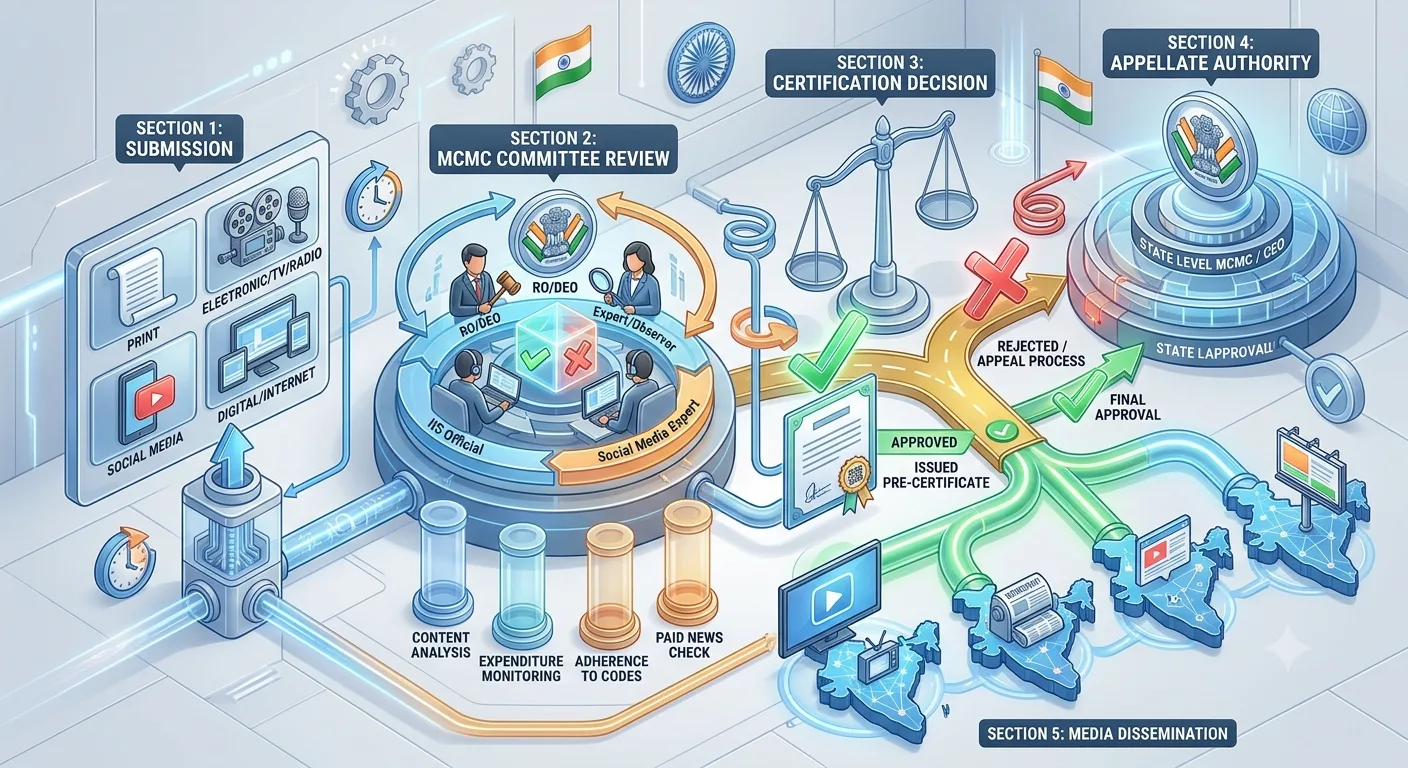
Any registered political party, any group of organisations or associations, or any contesting candidate or individual must apply to the Media Certification and Monitoring Committee (MCMC) for pre-certification of all political advertisements on electronic media before publication.
The media listed include TV, radio, AV displays at public places, e-papers and bulk SMS or voice messages, and the requirement covers social media too.
Individuals and contesting candidates can apply to the District MCMC. Registered political parties headquartered in a state or union territory can apply to the State Level MCMC.
Applications must be submitted within the specified timelines.
An Appellate Committee headed by the Chief Electoral Officer at state level hears appeals against decisions of the District or State MCMC.
No political advertisements are to be released to internet-based media or websites, including social media websites, without pre-certification from the respective MCMC.
The note also asks candidates to share details of their authentic social media accounts in their nomination affidavit, and refers to Section 77(1) of the Representation of the People Act, 1951, under which parties should submit a statement of expenditure on internet and social media campaigning to the ECI within 75 days of completion of the elections.
What the note does not tell you
Reading the note carefully matters as much as reading its headline. It does not tell you:
That the same rule applies to your election. The note was issued for specific elections. Each election has its own orders.
The exact timelines for submitting applications. The note says "specified timelines" without stating them. Those come from the relevant state or district authority.
Whether a particular message counts as a "political advertisement". That is a classification question about your content, your channel and your audience.
What the 2027 Assembly elections will require. As of 24 October 2026, press reports say several states are due for elections in 2027, but official dates have not been announced.
Any article, vendor or adviser that gives you a firm universal answer without these caveats is going beyond the document.
A verification checklist for campaign teams
Run this check for each election and each channel. Do it before you finalise templates or schedules, not after.
Identify the election. Which state, which election and which phase? Rules are issued for each.
Find the current orders. Start from the Election Commission's Model Code of Conduct page, and then the website of the state's Chief Electoral Officer. Look for orders on political advertisements, MCMC and bulk SMS or voice messages.
Record the date and number of each order you rely on. Orders can be revised.
Classify the content. Is this message a political advertisement? Ask the MCMC or a qualified adviser, giving the exact text, the channel and the audience.
Identify the right committee. District MCMC or State Level MCMC, based on who is applying.
Note the application timeline. Work backwards from your planned send date and leave time for corrections and appeal.
Prepare the application materials that the committee asks for. These typically relate to the content itself, so keep the final text, language versions and any audio files together.
Lock the certified version. After certification, the content that is sent must match what was certified. Treat any change as a new version that needs its own check.
Keep the certificate and records in your campaign file.
Tell your vendor which messages are certified and which are not.
Where this check fits in the workflow
MCMC pre-certification is an election-specific approval. It is separate from the telecom setup that TRAI's guidance describes for senders: registering as a Principal Entity, registering headers and content templates, and passing the identifiers to telecom service providers. TRAI's page states that failing to follow those steps will not allow you to send. The two checks answer different questions. Telecom setup asks whether you are an authorised sender with a registered template. Pre-certification asks whether this political content is cleared for publication. Our TRAI and DLT checklist covers the first, and this guide covers the second.
In a release workflow, the order is typically: finalise content, check classification, obtain certification where it applies, register or confirm the template for the certified text, test send, and release. If you reverse the order, you risk registering a template for text that later changes. For the full SMS process, see our bulk SMS setup checklist for election campaigns.
Voice messages, SMS and other channels
The ECI note names bulk SMS and voice messages together within electronic media. It also covers social media and internet-based media. In practice, your verification should be channel-specific: SMS text, a recorded voice file and a social media post are different pieces of content, and each may need its own certification record. If your campaign uses voice, keep the final audio file and its transcript with the certification record, since the audio is what recipients actually hear. Also check how the committee wants audio content submitted.
Common mistakes
Relying on last election's rules. Always check the orders for your election.
Assuming a vendor handles it. The applicant for certification is the party, group or candidate. A vendor can remind you but does not hold your approval.
Changing text after certification. A small edit can mean the sent message no longer matches the certified one.
Starting too late. Application timelines, corrections and appeals take time.
Treating DLT approval as certification. They are different approvals from different bodies.
Guessing classification. If you are unsure whether something is a political advertisement, ask before you send.
Records to keep
The election orders you relied on, with date and number.
The final text or audio of each message, in each language.
The application, the certificate or decision and any appeal.
The template and sender details used for sending.
The send log and delivery report for each batch.
These records help if a question arises later, and they support your expenditure documentation. Our wider guide on building a communication plan before the campaign starts shows where to keep them in your workflow.
Frequently asked questions
What is MCMC pre-certification?
It is the process by which a Media Certification and Monitoring Committee clears a political advertisement before it is published. The Election Commission's note of 20 March 2026 required it for political advertisements on electronic media, including bulk SMS and voice messages and social media, for the elections it covered.
Does this apply to the 2027 Assembly elections?
That depends on the orders issued for those elections. As of 24 October 2026, official polling dates for 2027 have not been announced. Check the Election Commission and the relevant state Chief Electoral Officer once the schedule is released.
Who applies to the MCMC?
According to the 20 March 2026 note, individuals and contesting candidates apply to the District MCMC, and registered political parties headquartered in a state or union territory apply to the State Level MCMC.
Is a message about a venue change a political advertisement?
It depends on the content and context. Do not assume either way. Ask the MCMC or a qualified adviser, with the exact text and channel.
Does DLT registration replace MCMC certification?
No. DLT registration is telecom setup for sending SMS. MCMC certification is an election-specific approval of the content. Where both apply, you need both.
What if an MCMC rejects my application?
The 20 March 2026 note says an Appellate Committee headed by the Chief Electoral Officer is constituted at state level to hear appeals against MCMC decisions. Check the process and timeline for your election.
Sources checked
Election Commission of India, Press Note No. ECI/PN/038/2026, "Political Parties to get advertisements pre-certified by MCMC", dated 20 March 2026. Checked 24 October 2026.
Election Commission of India, Model Code of Conduct page. Entry point for current orders. Checked 24 October 2026.
TRAI, Advice to Senders / Telemarketers, last updated 23 October 2026 as shown on the page. Checked 24 October 2026.
SMSNiti's bulk SMS service supports sender and template setup and per-number delivery reports for campaign messages. It does not certify content. Bring your certification status with you when you plan a send.