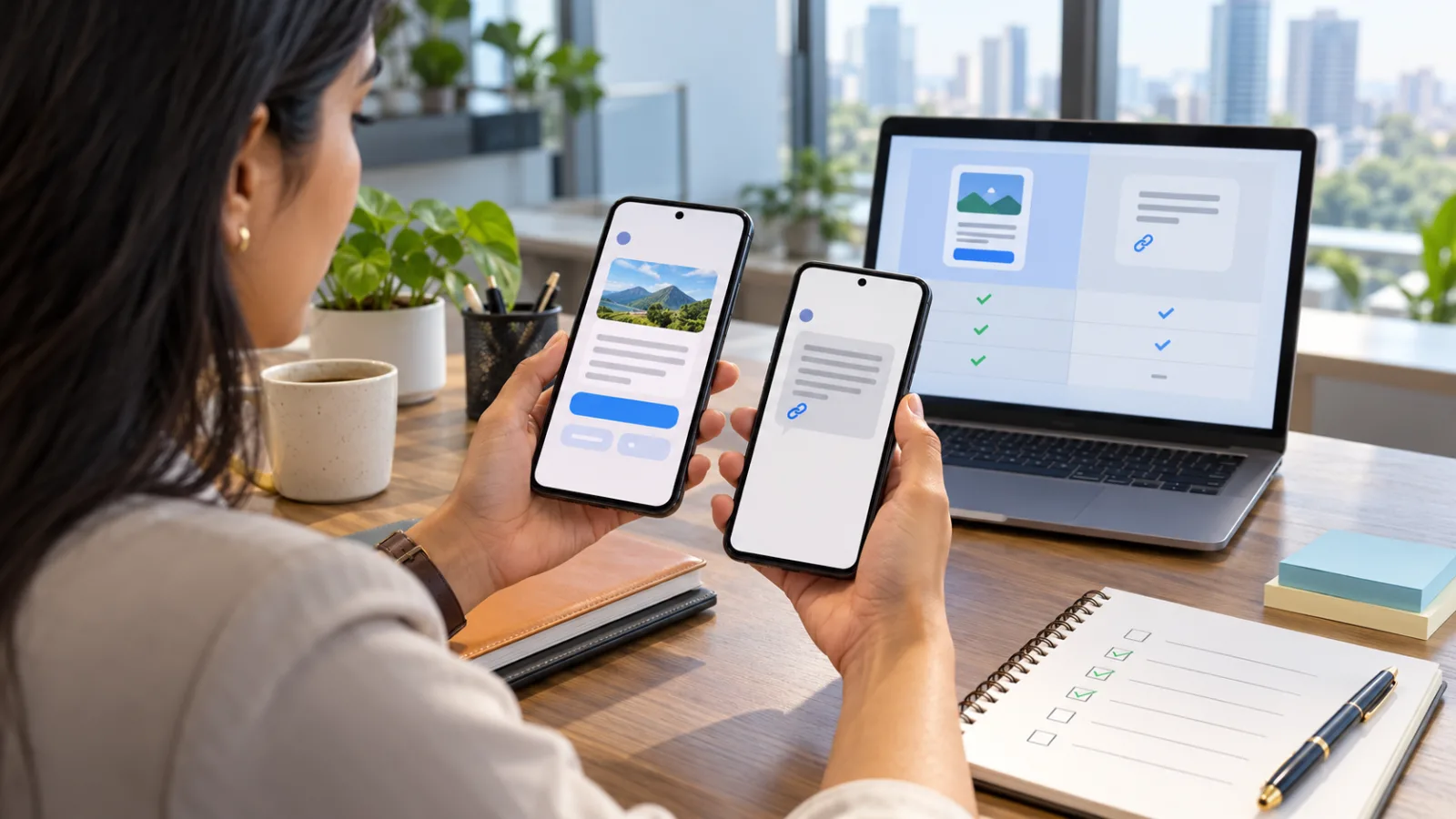
RCS changes a business message from a simple text-and-link format into a richer interaction where the recipient’s device, carrier, region and business-messaging setup support it. SMS remains a useful text channel with broad phone reach. The practical choice is not “rich versus old”; it is whether the extra content or interaction improves the customer task enough to justify checking RCS availability, supporting a fallback and testing a more involved experience. SMSNiti’s RCS messaging service is the relevant path when a campaign needs rich, verified business messaging on supported devices. For the operational SMS planning pattern used as a fallback comparison, read the bulk SMS campaign planning guide.
For RCS for Business, Google documents capability checks and says that a device that cannot receive RCS can be reached through another service such as SMS. Google Messages also notes that RCS availability varies by region and carrier. Do not assume that every contact, device or network can receive the same RCS experience. Review the current RCS for Business capability guidance and Google Messages RCS availability information for the exact implementation.
What changes when a campaign uses RCS?
RCS can support a more expressive message with media, rich cards, suggested actions or replies, depending on the business-messaging product and what a recipient’s device supports. SMS is generally planned as concise text, often with a link or a reply instruction. Which format is useful depends on the task: a photo or structured choice may help someone compare options, while a brief appointment reminder may not need a richer message at all.
Think of RCS as a set of capabilities to verify, not a guaranteed design. Google’s RCS for Business documentation describes checking the recipient’s device capabilities and tailoring the experience. Some checks can be estimates or stale, and the available features depend on the user and the implementation. A campaign should still make sense if the intended rich interaction is unavailable.
Compare the channels by the job to be done
Message format: RCS can support rich media and interactive elements when available; SMS is planned around concise text, a link, or a response path supported by the sender’s setup.
Recipient availability: RCS availability depends on the device, region, carrier and business-messaging agent support. SMS may be the chosen alternative for recipients who cannot receive the planned RCS experience, subject to the implementation and sender rules.
Customer task: Use rich content when it helps a person inspect information or choose a next step. Use a simple message when the information is short and familiar.
Operational work: RCS needs capability checks, approved agent setup and fallback behaviour. SMS needs its own sender, template and audience checks in India where applicable.
Failure handling: An uncertain RCS response is not proof that the message was not delivered. Check delivery receipts and follow the provider’s documented fallback procedure to prevent duplicates.
These are planning distinctions, not a guarantee of delivery, pricing or feature availability. Confirm the live product setup and current provider terms before selecting a route.
Start with the recipient’s task
Write one sentence describing what the person needs to know or do. Then ask what information belongs in the message itself and what should be on a destination page. A campaign inviting customers to compare a few product options may benefit from clear visual cards if the recipient can receive them. A short service update may be easier to understand as one sentence and a relevant link.
Keep one primary action. If a rich message contains multiple buttons, each should lead somewhere useful and labelled in plain language. Avoid building an interface simply because the channel permits one. Too many choices can make the next step harder to identify, and a large payload is not automatically more helpful than a concise SMS.
Check the destination and any linked terms on a phone. Confirm that prices, dates, eligibility, stock, service details and response expectations match the message. Do not make claims about an interactive feature until the actual campaign configuration has been tested on a supported device.
Plan reach and fallback before choosing creative
Before producing an RCS asset, determine what the chosen platform can check about the planned recipients and how current that information is. Google’s capability documentation explains that per-user checks return supported features when the number has recently connected to the RCS service; bulk capability results can estimate reach but do not identify every feature and may not be current. Use the method your provider actually supports, record its limits and avoid treating an estimate as a guarantee.
Decide what happens when RCS is not reachable. Will the person receive an SMS version, be omitted from the campaign, or be routed to another approved channel? The answer depends on the message’s purpose. A useful fallback preserves the same essential information, identifies the sender and keeps the requested action available. If the rich version contains details that the SMS version cannot convey clearly, simplify the RCS creative or choose a destination page that can present the full context.
Prevent duplicate messages. Google’s RCS for Business best-practice guidance says to check delivery receipts before triggering SMS fallback and not to assume a connection timeout means the RCS message failed. Follow the provider’s current receipt, revocation and fallback process. If the state is inconclusive, use a defined exception path instead of immediately sending both versions.
Check Indian sender and audience requirements
When SMS is part of a campaign in India, confirm the applicable setup for the message purpose and recipient group with the responsible telecom provider. TRAI’s sender guidance describes Principal Entity registration, headers, content templates and consent processes where applicable. The exact checks depend on the communication type and current requirements, so confirm them for the proposed campaign. Read TRAI’s advice to senders and the provider’s current instructions.
Do not assume that an RCS capability check establishes consent to send a marketing message. Reachability is a technical question; permission and audience eligibility are separate campaign checks. Keep permission evidence, suppression rules, message purpose and channel selection linked to the campaign record. If a customer has opted out or the business cannot explain why the message is expected, remove that recipient from the send.
Build a channel decision process
State the customer outcome. Identify the information the recipient needs and the single action the message supports.
Choose the simplest format that works. Use an RCS card or response control only when it makes the task clearer than plain text.
Check recipient and network readiness. Use the capability and reach methods provided for the exact RCS product, and document what they cannot tell you.
Design the fallback. Write an SMS version or decide how unsupported recipients will be handled. Ensure it preserves the essential meaning and destination.
Validate audience permission and sender setup. Check the purpose, list source, opt-outs, templates, sender identity and applicable channel requirements.
Test status and duplicate handling. Confirm how delivery receipts, errors, timeout and fallback decisions are interpreted before running a real campaign.
Review results by channel. Label RCS and SMS outcomes separately and explain any differences in availability or measurement.
Test the customer experience and the operations
Test on devices and networks that represent the campaign’s intended audience, including an unsupported or unavailable RCS case where possible. Check the sender identity, image crop, rich-card content, button labels, destination, SMS fallback, language variants and what happens when the customer is offline or a message expires. A preview in a console is not a substitute for a recipient-side test.
Also check how operators will know what happened. Identify the field or receipt that indicates RCS status, how long the system waits before a fallback decision, what records are saved, who investigates an inconclusive result and how to prevent two copies of the same message from reaching one person. Ask the provider to explain statuses in writing; do not treat “submitted” or “accepted” as equivalent to “delivered.”
Assign an owner for pausing the campaign if the creative, audience or route differs from what was approved. Keep the approved content and fallback pair together. If the RCS version changes after review, repeat the checks for the affected text, media, button, destination and corresponding SMS version.
Measure what the channel can actually show
Define measures before launch. Depending on the system, the team may observe attempted sends, provider-reported delivery, rich-action selection, link visits, replies or a completed business action. Keep these events distinct. A rich-card interaction is not automatically a purchase, and an SMS delivery report does not prove that the recipient read the message.
Compare like with like. If RCS reach was limited to recipients whose devices passed a capability check while SMS went to a wider group, the audiences differ. State that limitation in the report. Review whether the richer format helped the task and whether its additional setup, review and support work was justified by evidence the business can observe. Do not present a small or unrepresentative test as a universal result.
Campaign checklist: RCS, SMS or both?
The customer task is clear and the RCS experience solves a real information or interaction need.
Supported recipients and capability-check limits are understood for the chosen implementation.
The SMS path, suppression logic and deduplication behaviour are documented.
Message content, buttons, links and sender identity are tested on representative devices.
Indian SMS sender, template, consent and preference requirements have been checked where applicable.
Operators know how to read receipts, handle uncertain delivery and pause a campaign.
Results will distinguish delivery, interaction and completed business actions.
Frequently asked questions
Does RCS work on every phone?
No. Google says RCS availability varies by region and carrier, and RCS for Business also depends on device capability and whether the business agent is launched on the relevant network. Check availability for the specific audience and implementation.
Is SMS automatically sent when RCS is unavailable?
Not in every setup. A business must define and verify fallback behaviour in its infrastructure or provider workflow. Do not assume that a failed request, timeout or missing status means the RCS message was not delivered.
When should a campaign use SMS instead of RCS?
SMS may be the more practical option when the message is short, the richer experience does not improve the task, or RCS reach cannot be established for the intended audience. Confirm the current channel capabilities and applicable sender rules.
Can an RCS campaign and SMS fallback be measured together?
They can be reported in one campaign view if each channel’s events remain distinguishable. Define what counts as attempted, delivered, interacted with and completed, and document where the audiences or status definitions differ.
Choose a route that is clear and recoverable
Confirm the current RCS service scope with the provider and account for supported phones. Verify provider support, reach, fallback and sender requirements for your own campaign before finalising its creative.