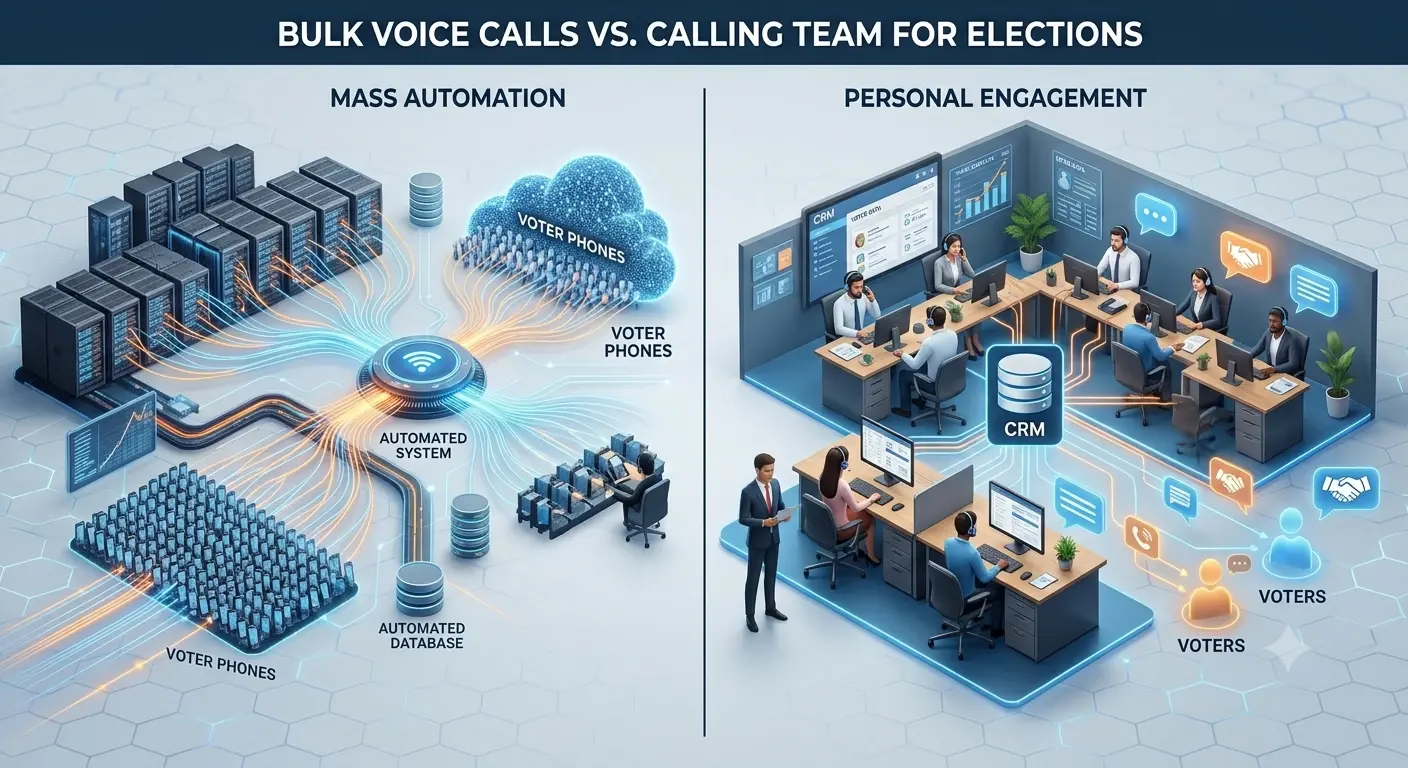
Use a bulk voice call when one message needs to reach many people and a key press is enough of a reply. Use a calling team when people need to talk, ask questions or be answered one to one. Most campaigns end up using both, with the recorded call opening the door and the team following up where a person has asked for it.
It sits inside our wider guide to political campaign marketing in India. It is about choosing between two ways of using the phone. To compare voice providers, see our review of bulk voice call services for elections.
By Rupali Dahiwal. Last updated: 10 November 2026. This is operational guidance, not legal advice.
The channels, the approvals and the set-up steps for this kind of work are on our election campaign SMS service page.
What does each one do?
A bulk voice call, also called voice broadcasting, plays one recorded message to many numbers in one campaign. Listeners can press a key to reply, for example to ask for a call back or to opt out, and the report shows who answered and what they pressed. A calling team is a group of people, with scripts and supervision, who ring numbers one at a time and talk to whoever answers. The first is fast and cheap per contact but cannot hold a conversation. The second can, but it is slow and costs by the hour.
When is a recorded call enough?
When the message is short and the same for everyone. A rally invitation with the venue and time, a polling-day reminder from the candidate, a notice that a meeting has moved, a thank-you after the campaign. It also suits audiences who find reading in a second language hard, older listeners and places where mobile internet is patchy, as our guide to bulk voice calls for elections explains. Keep it to twenty or thirty seconds, say who is calling and why in the first sentence, and offer one action. Our voice recording brief shows how to write one.
When do you need people?
When the call has to answer questions, take a detail down or hear a problem. Volunteer coordination is a good example: confirming who can attend, what time and where. So is following up on people who asked for a call back, or checking that an event notice reached the right ward. A recording cannot do any of that. A person with a script and a list can.
How do the costs differ?
We do not give prices here, because they depend on the provider and the volume. The structure is what matters. Bulk voice calls are usually billed by call length, rounded to a set interval, so a shorter message costs less. A calling team is billed by people and time: training, supervision, a script, and hours on the phone. Add the cost of the follow-up too, because a recorded call that produces many call-back requests creates work for the team. Our cost factors guide explains what drives the price of each channel.
What rules apply to each?
Voice messages are covered by the Election Commission's order of 20 March 2026 on pre-certification of political advertisements, so the script has to be approved before the recording is used. A voice clip is also checked by the operator's team, which takes time. The silence period applies to election communication, and our guide to the election silence period shows how to verify the window and put it in your calendar as a hard stop.
We do not cover the legal position of live calls made by a team, and you should check that with your adviser. What we can say is that the same habits apply: approve the script first, respect sending hours, keep a list of people who asked not to be called, and stop when the pause begins.
How can the two work together?
Send a recorded call with a key-press menu: press 1 to be called back, 9 to stop.
Export the report and build a call-back list from the people who pressed 1.
Add everyone who pressed 9 to your suppression list, and keep them out of later campaigns.
Give the call-back list to the team with an approved script and a time window.
Record outcomes in one sheet, so nobody is called twice.
That way the team spends its hours on people who asked to talk, not on cold lists. It also gives you a clean record of consent for the follow-up.
What mistakes should you avoid?
Using a long recording for something that needed a conversation. Giving a calling team a list with no suppression, so people who opted out are called again. Starting calls outside the sending hours, since every service has its own limits and we do not run campaigns after 8 pm. Letting a team improvise instead of using an approved script. And leaving the pause to the last minute. A correction and pause workflow agreed in advance covers a wrong message on either channel.
Not every call will be answered. Plan for delivery of up to about 75 per cent, because of invalid numbers, DND and other issues in the ecosystem.
Frequently asked questions
Is a bulk voice call enough for an election campaign?
For announcements and reminders, yes. If people need to ask questions or talk, add a calling team for the follow-up.
Can a recorded call collect replies?
Yes, through key presses, such as pressing 1 for a call back. The report shows who pressed what.
Do voice messages need approval?
The Election Commission's order of 20 March 2026 requires pre-certification of political advertisements, including bulk SMS and voice messages. The operator also checks voice clips.
How many calls will be answered?
Not all of them. Plan for delivery of up to about 75 per cent, and for fewer answers than that.
Sources checked
Election Commission of India, Press Note No. ECI/PN/038/2026 dated 20 March 2026. Checked 10 November 2026.
TRAI, Advice to Senders / Telemarketers, last updated 23 October 2026 as shown on the page. Checked 10 November 2026.
Smsniti bulk voice call service page. Checked 10 November 2026.
Tell us where you are campaigning and when, on the election campaign SMS, voice and WhatsApp service page, and we will say what can be done.