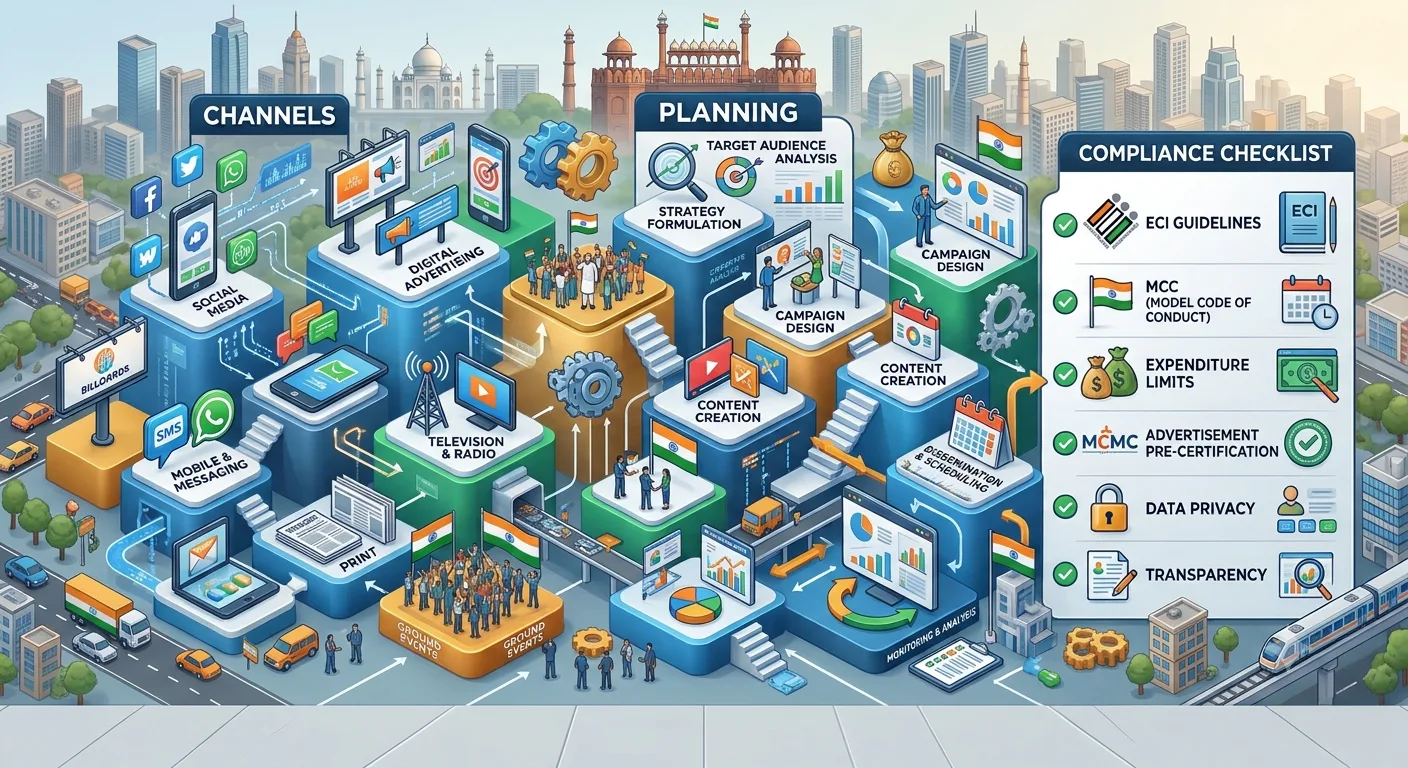
Political campaign marketing in India means planning, approving, sending and measuring a campaign's communication, through channels such as bulk SMS and voice calls, within telecom rules and the Election Commission's directions. Delivery is the easy part. The harder part is knowing who approves each message, which checks come first and who can pause a release.
This guide is the starting point for campaign agencies, political consultants and operations teams who run political campaign marketing in India and want a clear order of work. It links to detailed guides on vendor selection, outsourcing, bulk SMS setup, MCMC pre-certification and TRAI and DLT setup. Read the whole page once, then use the section links as a checklist.
By Rupali Dahiwal. Last reviewed: 24 October 2026. This is operational guidance, not legal advice. Election rules change from one election to the next, so confirm current orders for your election before you send anything.
What political campaign marketing covers (and what this guide does not)
In practice, political campaign marketing in India covers the communication work around a campaign. That includes event and venue notices, helpline numbers, published-schedule reminders, volunteer coordination, public updates and approved campaign messages sent by SMS or voice call. It also covers the supporting work: message approvals, language review, sender setup, reporting and record-keeping.
This guide does not cover persuasion strategy, voter profiling, targeting by sensitive traits, or what a campaign should say. Those are political decisions for the campaign. SMSNiti's role in this space is the messaging channel: it provides a bulk messaging platform that campaigns can use, and the campaign stays responsible for what it sends and for the approvals that content needs.
Keeping this line clear helps in two ways. It keeps your vendor conversations specific, because you are buying delivery and workflow, not political strategy. It also keeps your compliance questions specific, because the rules differ by channel, content type and election.
Step 1: Build the communication plan before you pick a channel
Teams that start with the channel usually end up rewriting their plan. Start with five decisions instead:
Purpose of each message. A venue change, a helpline number and a published-schedule reminder are different jobs. Write one sentence for each.
Who may receive it, and on what basis. Know where each contact list came from and what permission exists for it.
Language and version. Decide which languages you need, who reviews each one and who signs off.
Who approves, and who can stop a send. Name a person, not a team.
What you will report afterwards. Decide the metrics before the first send, not after.
If you want a worked structure, SMSNiti's guide on building a communication plan before the campaign starts walks through the pre-campaign checklist in more detail.
Step 2: Compare SMS and voice
No channel is best in every case. The right mix depends on the message, the audience’s phone access, the approval time you have, and how much reply handling your team can manage. The comparison below sets out the two channels this guide covers, side by side on the same points.
Bulk SMS
Best suited to: short, factual notices with a date, place or number.
Typical content: venue or time change, helpline, schedule reminder.
Telecom setup: sender registration and content templates on DLT.
Main risk: template rejection, a wrong link, unreviewed edits.
Reply handling: limited, unless you add a number or link.
Reporting: delivery status per number.
Service page: Bulk SMS service.
Bulk voice calls
Best suited to: recorded messages where audio or a regional-language voice matters.
Typical content: an approved recorded announcement or reminder.
Telecom setup: voice-specific provider setup under telecom rules.
Main risk: poor pronunciation, the wrong script version, unwanted calls.
Reply handling: limited, unless a call-back or menu is set up.
Reporting: call status and duration reports from the provider.
Service page: Bulk voice call service.
WhatsApp: check the policy first
WhatsApp’s Business Messaging Policy, shown as last updated on 23 September 2026, lists political parties, politicians, candidates and campaigns, and entities offering political campaign services, among those prohibited from using its business messaging platform. For that reason this guide covers SMS and voice only. If you are considering WhatsApp in any way for campaign communication, read the policy and confirm with WhatsApp before you act.
Two cautions apply to every channel. First, a channel being technically available does not mean a message may be sent on it. Content approval and telecom setup are separate checks. Second, reach figures are not promises. Delivery depends on the recipient's number, network and device, so treat any vendor that guarantees a reach percentage with care.
How to choose, in practice
If the message is a short, factual notice, start with SMS.
If the audience prefers audio, or reads less comfortably in a particular script, test a voice message.
If you are unsure, run a small, reviewed test before a large release.
For a deeper comparison, read SMS vs voice calls for election campaigns. For channel-specific planning, see SMSNiti’s guides on planning a bulk SMS campaign and a bulk voice campaign.
Step 3: Treat compliance as two separate tracks
The most common mistake in political campaign marketing in India is mixing up two different sets of checks. Both can apply to the same message. Passing one does not satisfy the other.
Track A: Telecom setup (TRAI and DLT)
For commercial SMS, TRAI's guidance for senders lists the steps that must be completed before a message can be sent: register as a Principal Entity, register a header (the sender name), register content templates, pass the Principal Entity ID, header and content ID to the telecom service providers, and, where applicable, collect consent through a registered consent template. TRAI's page states that failing to follow any of these steps will not allow you to send. See TRAI's advice to senders.
On who decides: in a press note dated 8 September 2025, TRAI said it has no role in accepting or rejecting individual SMS campaigns, and that approval or rejection of SMS message templates is carried out by the telecom service providers under the TCCCPR 2018 framework. In practice, that means your template goes to the operators' DLT process, not to TRAI. Our TRAI and DLT checklist for election-related SMS covers the questions to settle before launch.
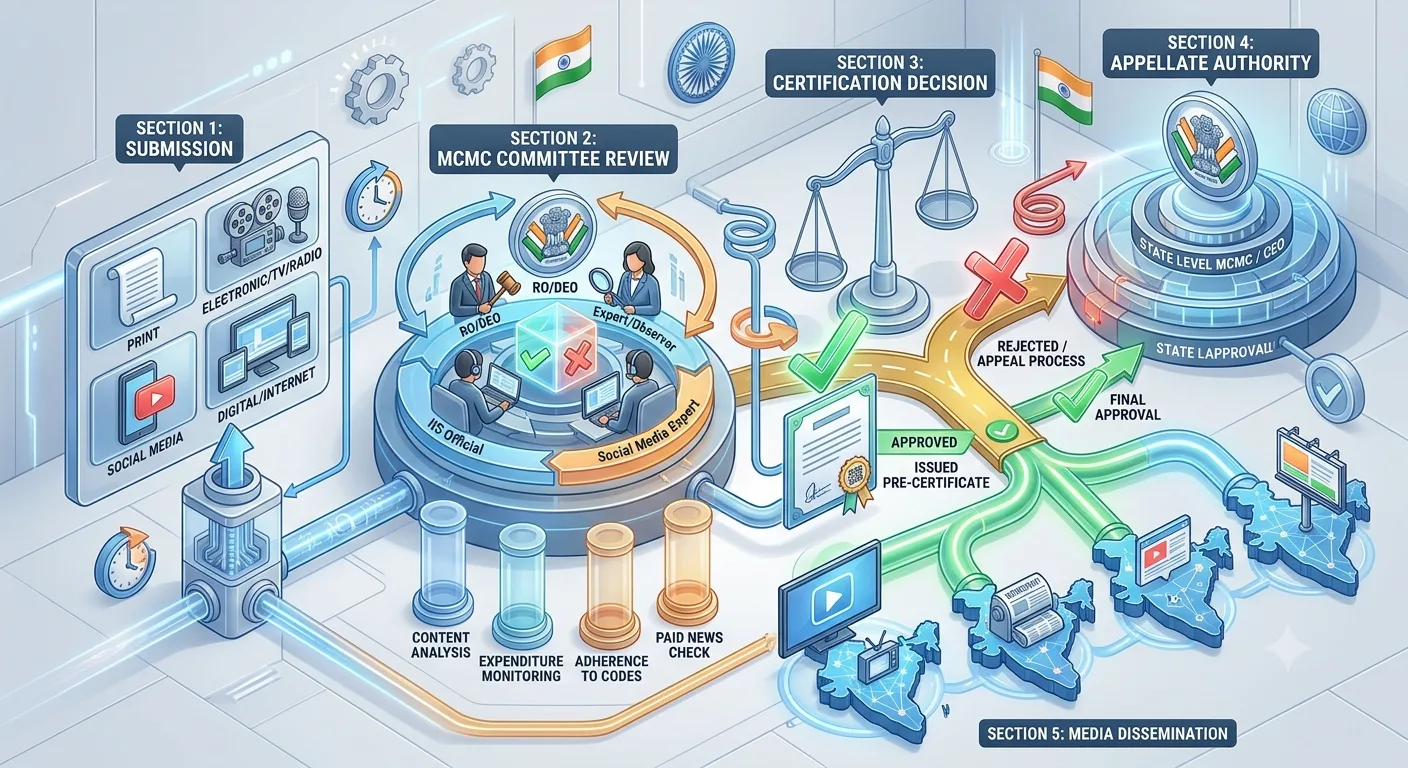
Track B: Election-specific approval (ECI and MCMC)
The Election Commission has issued election-specific directions on political advertisements. In its press note No. ECI/PN/038/2026 dated 20 March 2026, issued for the elections announced on 15 March 2026, the ECI said any registered political party, group of organisations or associations, or contesting candidate must apply to the Media Certification and Monitoring Committee (MCMC) for pre-certification of all political advertisements on electronic media before publication. The note lists electronic media as TV, radio, AV displays at public places, e-papers and bulk SMS or voice messages, and says the requirement also covers social media.
The note also says contesting candidates apply to the District MCMC, registered parties headquartered in a state or union territory apply to the State Level MCMC, applications must meet the specified timelines, and an Appellate Committee headed by the CEO handles appeals. That note applies to those 2026 elections. For any other election, including the 2027 Assembly elections, check the orders issued for that election. Our guide to MCMC pre-certification explains how to run that check.
Whether a particular message counts as a "political advertisement" is a classification question. Do not guess. Ask the MCMC or a qualified adviser, with the actual content, channel and audience in hand.
Step 4: Handle contact data responsibly
A campaign's contact list is both its main asset and its biggest risk. Before any send, a team should be able to answer these questions:
Where did each list come from, and for what purpose was it collected?
What permission or consent record exists, and where is it stored?
Is there a suppression list so that people who ask to stop are not messaged again?
Who can download or export the list, and is that access logged?
How long will the list be kept, and who deletes it?
Avoid building segments from sensitive attributes such as religion, caste or inferred political views. That is a legal and reputational risk, and it is outside what this guide recommends. Use operational segments instead, such as language, district or the event a person registered for.
Step 5: Set up an approval and release workflow
Most campaign communication errors are workflow errors: the wrong version goes out, a link is broken, or a correction takes hours because nobody owns the pause button. A simple workflow prevents most of them:
Draft from one master copy. Every channel version comes from it.
Fact check every date, place, number and name.
Language review by a native speaker for each language.
Compliance check against both tracks above, including MCMC status where it applies.
Test send to an internal list. Open every link.
Release by a named person, with the final version stored.
Pause and correct through a documented process if something is wrong.
The test send is the step teams skip most often and regret most. It takes minutes, and it catches broken links, garbled regional-language characters and wrong merge fields.
Step 6: Decide what to outsource
You do not have to build every capability in-house, and you do not have to outsource everything. A sensible split is to keep decisions about message content, approvals and audience with the campaign, and to use a vendor for channel infrastructure, sender setup, delivery and reporting. Our guide on what to outsource and what to keep in-house includes a scope matrix you can adapt, and the guide on choosing a political campaign communication service provider gives a scorecard for comparing vendors.
Step 7: Measure delivery without overclaiming
Reports can tell you what was sent, what the provider reports as delivered, and, on some channels, what was read or replied to. They cannot tell you whether a message changed anyone's opinion or vote. Keep these separate in every report:
Sent: messages submitted to the provider.
Delivered (provider-reported): messages the network or platform confirmed.
Responded: calls, replies or link clicks, where measured.
Issues: complaints, wrong versions, corrections.
Do not publish benchmark delivery rates unless you can point to your own logged data. For a campaign-review structure, see how to plan a bulk SMS campaign from brief to post-campaign review.
The 2027 Assembly elections: what is known and what is not
As of 24 October 2026, press reports say several states are due for Assembly elections in 2027, including Goa, Punjab, Uttarakhand and Uttar Pradesh, but official polling dates have not been announced. Treat any date you see in a plan as provisional until the Election Commission publishes the schedule. When it does, re-read the orders issued for that election before you finalise your sender setup, approval timelines and pause windows. Do not hard-code dates into your calendar.
Common mistakes to avoid
Treating DLT approval as election approval. They are separate checks.
Treating one election's order as permanent. Rules are issued per election.
Sending from unverified lists. You cannot fix a list's origin after a complaint.
Skipping the test send. Broken links go to thousands of people at once.
No named pause owner. A correction that waits for a meeting is a correction that comes too late.
Reporting delivery as impact. Delivered is not persuaded.
Blogs in this cluster
Use these guides for the detail behind each step above.
How to Choose a Political Campaign Communication Service Provider in India: a scorecard for comparing vendors.
Political Campaign Marketing Services: What to Outsource and What to Keep In-House: a scope matrix for the make-or-buy decision.
Bulk SMS for Election Campaigns: Setup, Message Review and Delivery Checklist: from sender setup to test send.
Political Advertisement Pre-Certification in India: What Campaign Teams Must Verify: how to check MCMC requirements.
TRAI, DLT and Bulk SMS Setup for Election-Related Communications: the telecom questions to settle.
SMS vs Voice Calls for Election Campaign Communication: How to Choose: how to match each message to a channel.
Election Campaign SMS Message Formats: Neutral Examples for Dates, Venue and Public Updates: factual formats with template and length notes.
Bulk Voice Calls for Election Campaign Communication: Planning and Quality Checks: script, call flow, tests and reports.
How to Brief a Voice Recording for a Regional Election Communication: a production brief for regional-language audio.
What Should a Political Campaign Communication Brief Include?: the one-page brief that lets a provider quote and a team run.
Political Campaign Communication Costs in India: What Determines the Budget?: cost drivers and a quote worksheet, with no invented rates.
A 90-Day Political Campaign Communication Calendar: six phases with gates, built on relative dates.
Political Campaign Communication Approval Workflow: From Draft to Release: roles, steps and version control.
How to Review Multilingual Political Campaign Messages Before Release: native-speaker review, SMS display and voice checks.
Campaign Contact Lists and Consent Records: A Responsible Data-Handling Checklist: provenance, consent, suppression and access.
How to Measure Campaign Communication Delivery Without Overclaiming Impact: what each metric means and cannot prove.
Election Silence Period and Campaign Pause Windows: A Verification Checklist for Agencies: how to verify windows and clear the send queue.
How Campaign Teams Should Pause and Correct a Wrong or Outdated Campaign Message: an eight-step pause and correction process.
WhatsApp and Political Campaigns: What the Business Messaging Policy Says: what the policy says and what to do instead.
How Political Campaign Agencies Can Build a Communication Plan Before the Campaign Starts: the pre-campaign planning checklist.
How to Plan a Bulk SMS Campaign From Brief to Post-Campaign Review: channel planning and review.
How to Plan a Bulk Voice Campaign With a Clear Recipient Outcome: voice campaign planning.
How to Evaluate a Communication Services Supplier Before Reselling: supplier evaluation criteria.
Frequently asked questions
Is political campaign marketing in India regulated?
Yes, in more than one way. Telecom rules set by TRAI govern how commercial messages are sent, and the Election Commission issues directions for political advertisements for each election. Which rules apply depends on the channel, the content and the election, so check both for your case.
Do political messages need MCMC pre-certification?
For the elections covered by its press note of 20 March 2026, the ECI required political advertisements on electronic media, including bulk SMS and voice messages, to be pre-certified by the MCMC before publication. For a later election, check that election's orders. Whether a specific message counts as a political advertisement is a question for the MCMC or a qualified adviser.
Is DLT registration enough to send election messages?
No. DLT registration is the telecom setup for sending SMS. It does not replace any election-specific approval that may apply to the content.
Which channel is best for a political campaign?
There is no single best channel. SMS suits short factual notices, and voice suits audio and regional-language reminders. WhatsApp’s Business Messaging Policy currently prohibits political campaigns from using its business platform, so check that policy before considering it. Test with a small reviewed batch before a large release.
Can I use any phone number list for a campaign?
Only if you can show where the list came from, what permission exists for the intended use, and how you will honour opt-outs. If you cannot, do not use the list.
Should a campaign outsource its communication?
Many campaigns outsource channel infrastructure and delivery, and keep content, approvals and audience decisions in-house. The right split depends on your team's capacity and risk tolerance.
Sources checked
Election Commission of India, Press Note No. ECI/PN/038/2026, "Political Parties to get advertisements pre-certified by MCMC", dated 20 March 2026. Checked 24 October 2026.
TRAI, Advice to Senders / Telemarketers (page shows last updated 23 October 2026). Checked 24 October 2026.
TRAI, Information Note to the Press dated 8 September 2025, "Clarification on Media Reports regarding rejection of SMS Campaigns". Checked 24 October 2026.
Election Commission of India, Model Code of Conduct page. Entry point for current election-specific orders.
WhatsApp, Business Messaging Policy, shown as last updated 23 September 2026. Checked 25 October 2026.
SMSNiti services directory and the bulk SMS and bulk voice call service pages, for the service descriptions used in the channel comparison. Checked 24 October 2026.
Planning a campaign and need a messaging channel? SMSNiti can talk you through sender setup, template approval and delivery reporting for your campaign. You remain responsible for your content and for any election-specific approvals it needs.