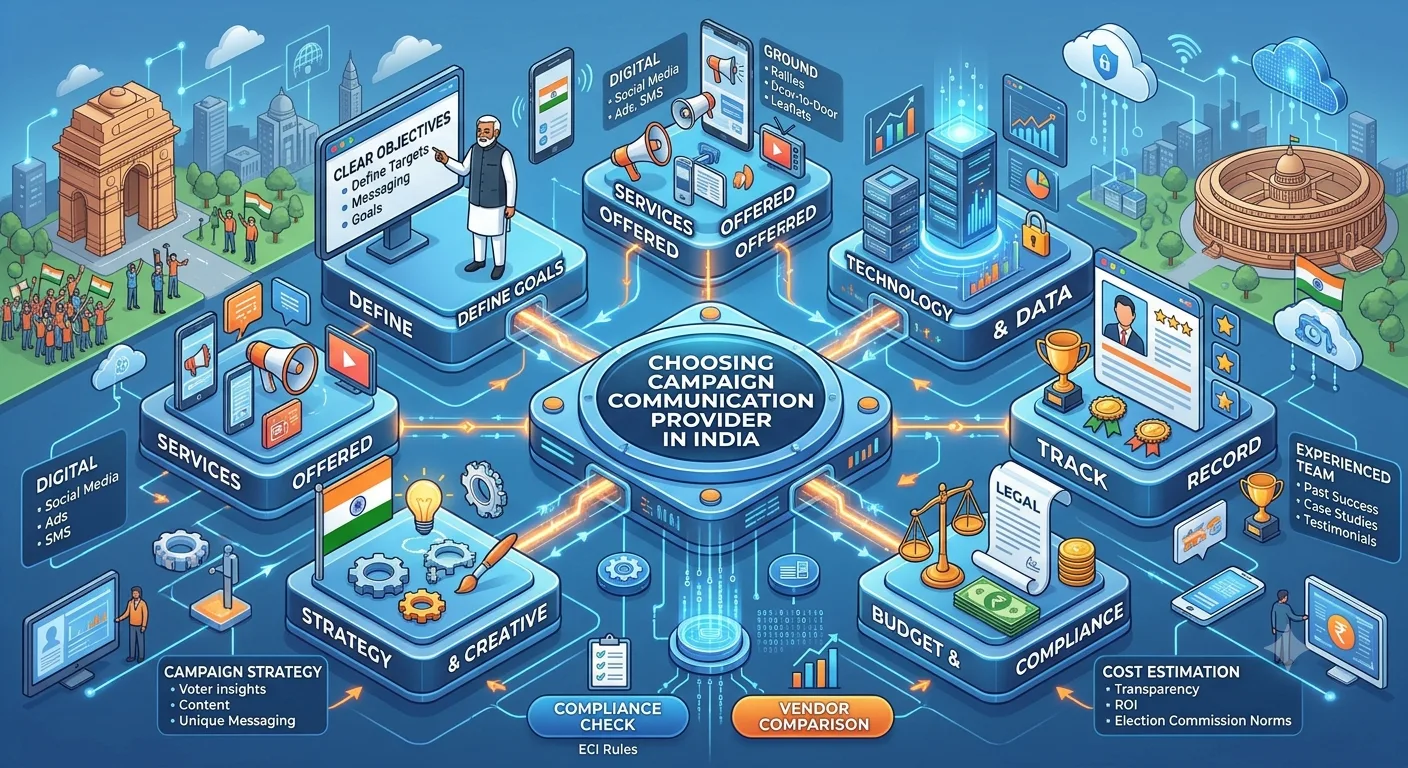
To choose a political campaign communication service provider, define your scope first, then score each vendor on the same criteria: channel capability, sender and template setup, approval workflow, data handling, reporting, support during peak days and exit terms. Ask for written answers, and treat any guarantee of reach or results as a warning sign.
Campaign teams usually compare vendors on price and promised reach. Those are the two weakest signals. This guide gives a scorecard you can use to compare any political campaign communication service provider on the things that decide whether a campaign runs smoothly: scope, approvals, data, reporting and support. It sits inside our wider guide to political campaign marketing in India, which explains the channels and compliance checks this scorecard refers to.
By Rupali Dahiwal. Last reviewed: 24 October 2026. This is operational guidance, not legal advice.
Step 1: Decide what you are actually buying
"Political campaign communication service provider" can mean very different companies. Before you collect quotes, decide which of these you need:
Channel infrastructure: a platform to send SMS or voice messages, with sender setup and delivery reports.
Campaign agency services: planning, creative production and media buying.
Political strategy or consulting: decisions about message, audience and positioning.
These are different businesses. A messaging provider such as SMSNiti supplies the delivery channel and the setup around it. It does not decide your message or your strategy. If a vendor claims to do everything, ask them to show you exactly which parts they deliver themselves and which they subcontract. For the make-or-buy question that comes before vendor selection, see our guide on what to outsource and what to keep in-house.
Step 2: Write a one-page scope before you request quotes
Vendors can only quote accurately against a clear brief. Your one-page scope should state:
Channels needed (SMS, voice) and the expected message types for each.
Languages and scripts, and who reviews each one.
Approximate sending volumes and the periods when volumes peak.
Who approves content on your side, and who can order a pause.
Reports you need, and how often.
The election or elections you are planning for. Rules differ by election, so say which.
Without this page, you will get quotes that look comparable but cover different things. That is how a cheap quote becomes an expensive project.
Step 3: Use a scorecard, not a feeling
Score each vendor from 0 to 3 on each row below, using written answers. Add up the total, then discuss the rows where vendors differ most.
Scope clarity. Ask: which parts of my brief do you deliver yourselves? A good answer is a clear list, with anything outsourced named.
Sender and template setup. Ask: who handles sender registration and template submission, and how are rejections handled? A good answer describes the process, names a contact and says honestly that operators make the final approval decision.
Election-specific checks. Ask: how do you handle content that may need election-authority approval? A good provider asks whether approval exists, and does not claim to grant it.
Approval workflow. Ask: can my reviewers approve content before release, and is the final version stored? A good answer is a defined approval step and a record of what was sent.
Language support. Ask: which languages and scripts do you support, and how do you test them? A good answer is a named list and a test-send step. SMSNiti's bulk SMS page, for example, lists regional languages such as Hindi and Marathi.
Data handling. Ask: who can access my lists, where are they stored and how are they deleted? A good answer covers role-based access, a retention policy and a deletion process.
Reporting. Ask: what does the delivery report show, and in what format? A good answer is per-number delivery status and a downloadable report, with definitions of each status.
Support on peak days. Ask: who do I reach in an urgent situation, and when? A good answer is a named escalation path and stated support hours.
Pause and correction. Ask: how quickly can a scheduled campaign be paused? A good answer is a documented process and a named contact.
Commercial terms. Ask: how is the quote built, and what is excluded? A good answer is a volume-based quote that lists inclusions and exclusions.
Exit. Ask: what happens to my data and logs when the contract ends? A good answer is export of reports and deletion of lists on request.
Step 4: Check the channel basics
A vendor does not need every channel, but it should be honest about the ones it offers. As a minimum for SMS, look for DLT registration support, sender ID and template help, scheduling, and delivery status for each number. For instance, SMSNiti's bulk SMS service lists web-panel and API sending, DLT registration help, template support and delivery status for every number. Compare any provider's published feature list against what you saw in the demo.
Pricing is a separate matter. Many providers, SMSNiti included, quote by volume and message type rather than publishing one rate, so ask for a written quote against your scope. Be careful with any provider that quotes a flat price without asking about volume, language or message type.
Step 5: Ask the compliance questions that matter
You cannot outsource responsibility for your content. You can, however, choose a provider that helps you avoid avoidable mistakes. Ask these questions in writing:
"Do you require proof of any election-specific approval before sending political content?" A careful provider will ask. A provider that never asks is leaving that risk with you.
"Who submits our templates to the operators, and what happens if one is rejected?" TRAI has said that approval or rejection of SMS templates is carried out by telecom service providers, so a vendor cannot promise approval.
"Can you show me the sender and template records for my account?" You should be able to see what is registered under your name.
"What do you do if I ask you to send content you believe may break a rule?" Their answer tells you how they behave under pressure.
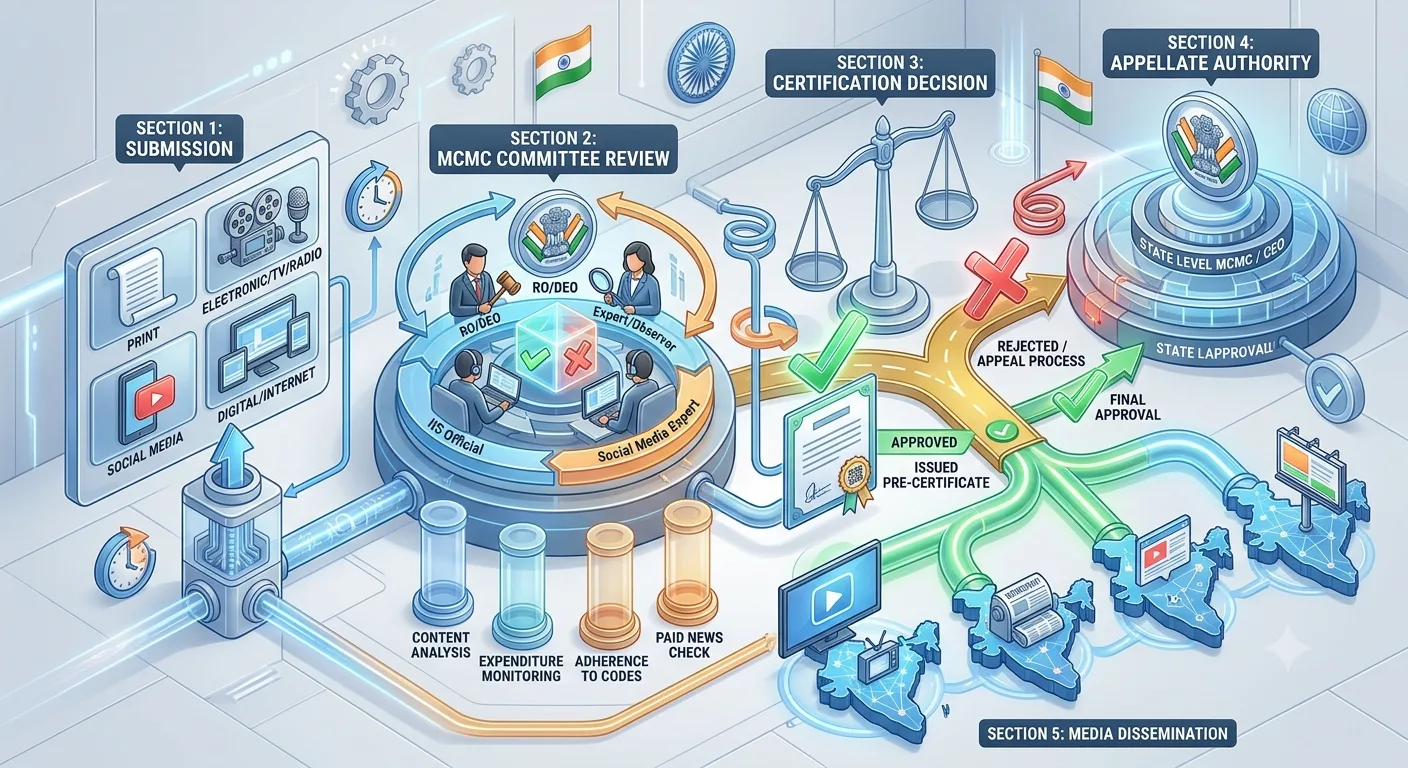
For the election-specific side, our guides on MCMC pre-certification and evaluating a communication services supplier cover the questions in more depth.
Red flags
Guaranteed reach or delivery percentages. Delivery depends on networks, devices and number status. No provider controls all of that.
"We handle all approvals." Template approval sits with operators, and election approvals sit with the relevant authority.
Unverifiable client lists. Ask for references you can contact. Do not accept names alone.
Selling contact lists. A vendor that offers lists of voters or phone numbers raises a serious data-origin problem.
No test-send step. If there is no way to check a message before it goes to everyone, the risk sits with you.
Vague answers on data deletion. You need to know what happens to your lists.
Pressure to commit quickly. A genuine provider can wait for you to compare options.
A hypothetical example of the scorecard in use
This is an illustrative scenario, not a real client case. Imagine an agency comparing three providers for a state-level campaign. Provider A is cheapest but cannot name who submits templates. Provider B is mid-priced, shows a clear approval step and offers per-number delivery reports. Provider C is the most expensive and promises a fixed delivery percentage. On the scorecard, B scores highest, A loses points on setup clarity, and C loses points for an unrealistic guarantee. The cheapest quote did not win, because the rows that decide campaign-week outcomes were weak.
Step 6: Run a small trial before you commit
Before a large contract, run a small, reviewed test:
Send a neutral, factual message to an internal list.
Check the delivery report and compare it with what your own team received.
Test a regional-language message and confirm the characters display correctly.
Raise a support question and note how long the reply takes.
Ask for a sample report and read the definitions.
A trial reveals more than a sales presentation. It also shows how the provider behaves when something does not work.
Decision rules for the final choice
Reject any vendor that guarantees outcomes or refuses to answer in writing.
Among the rest, prefer the one with the clearest scope and approval workflow, not the lowest price.
If two vendors tie, choose the one with the stronger support and pause process.
Record why you chose the vendor. It helps if questions arise later.
Frequently asked questions
What is a political campaign communication service provider?
It is a company that supplies the channels and workflow for campaign communication, such as bulk SMS or voice calls, along with sender setup and reports. It is different from a political consultancy, which advises on strategy.
Should I choose the cheapest provider?
Not on price alone. Compare scope, approval workflow, data handling, reporting and support. A low quote that excludes setup, reports or support can cost more in the end.
Can a provider guarantee message approval?
No. TRAI has stated that approval or rejection of SMS templates is carried out by telecom service providers. Election-specific approvals, where they apply, come from the relevant authority. A provider can help you prepare, but it cannot promise approval.
What documents should I ask a provider for?
Ask for a written scope, a quote with inclusions and exclusions, a sample report, a description of data handling and an escalation contact. If DLT setup is part of the work, ask what the provider needs from you.
How many providers should I compare?
Two or three is enough if you use the same scope and scorecard for each. More than that usually adds noise, not insight.
Sources checked
TRAI, Information Note to the Press dated 8 September 2025, "Clarification on Media Reports regarding rejection of SMS Campaigns". Checked 24 October 2026.
TRAI, Advice to Senders / Telemarketers, last updated 23 October 2026 as shown on the page. Checked 24 October 2026.
SMSNiti, bulk SMS service page, for the feature descriptions quoted above. Checked 24 October 2026.
If you would like to see how SMSNiti answers these questions for your campaign, you can ask for a written quote based on your scope. Bring the one-page scope from Step 2 and compare the answers against the scorecard above.