
For most campaigns, the safest split is to keep content, audience decisions and final approvals in-house, and to outsource channel infrastructure, sender setup, delivery and reporting. Decide the split task by task using three tests: who carries the legal and reputational risk, who has the skill, and who can act fast when something goes wrong.
Before you compare vendors, you need to decide what you are buying at all. Political campaign marketing services range from a messaging platform to a full agency, and the wrong split leads to either a bloated in-house team or a vendor making decisions that belong to the campaign. This guide gives a task-by-task scope matrix and a decision method. It is part of our wider guide to political campaign marketing in India.
By Rupali Dahiwal. Last reviewed: 24 October 2026. This is operational guidance, not legal advice.
Why the make-or-buy question comes first
Teams often start by asking which vendor to hire. That is the second question. The first is which tasks a vendor should do at all. If you skip it, you end up in one of two bad places:
Everything outsourced. The vendor writes, approves and sends. If a message is wrong, nobody on your side checked it, and the campaign still owns the consequence.
Everything in-house. Your team learns sender registration, template rules and delivery reporting during the busiest weeks of the campaign.
The aim is a split where each task sits with the party best placed to do it well and to answer for it.
The three tests for every task
Risk test: If this task goes wrong, who answers for it? Tasks that carry the campaign's name, such as message content, usually belong in-house.
Skill test: Who can do this well without a long learning curve? Technical setup, such as sender registration and delivery configuration, is often faster with a specialist.
Speed test: Who can act in minutes if a correction is needed? Pausing or correcting a message should never wait on a slow handoff.
If a task fails the risk test, keep it in-house or keep a named reviewer in the loop. If it passes the risk test and fails the skill test, consider outsourcing it.
Scope matrix: who does what
Use this matrix as a starting point and edit it for your team. "In-house" means the campaign or agency team. "Vendor" means a messaging provider.
Message content and facts: in-house. The campaign answers for what it says.
Audience and contact-list decisions: in-house. Data origin and permission are the campaign's responsibility.
Election-specific approval status (for example MCMC, where it applies): in-house, with an adviser. Classification depends on the exact content and election. A vendor should ask for proof, not supply it.
Language review and sign-off: in-house, with native reviewers. Translation errors damage trust fast.
Sender registration and template submission: vendor, with your documents. This is technical, repetitive work and the vendor knows the process. Operators make the approval decision.
Platform setup and sending: vendor. This is infrastructure, not strategy.
Test sends: shared. The vendor sends; your team verifies content on real phones.
Release authorisation: in-house. A named person on your side decides when to send.
Delivery reports: the vendor produces, you read. The vendor holds the data; you decide what it means.
Pause and correction: shared, with one named owner on each side. Speed matters more than hierarchy here.
Records and close-out: shared. You need the vendor's logs and your own approvals in one file.
A provider such as SMSNiti fits the vendor column: it supplies a bulk SMS platform with web-panel and API sending, DLT registration help, template support and per-number delivery status. The campaign keeps the rest.
What should stay in-house, and why
Content and facts
Every date, venue, name and phone number in a message should be checked by someone on your team who knows the facts. A vendor cannot verify that a rally time is correct. Treat the vendor as a delivery pipe, not a fact checker.
Audience and consent decisions
Who you contact, and on what basis, is the campaign's decision. Keep a record of where each list came from and what permission exists. If a vendor offers to supply a list, ask where it came from. A list you cannot trace is a liability you would be buying.
Election-specific approvals
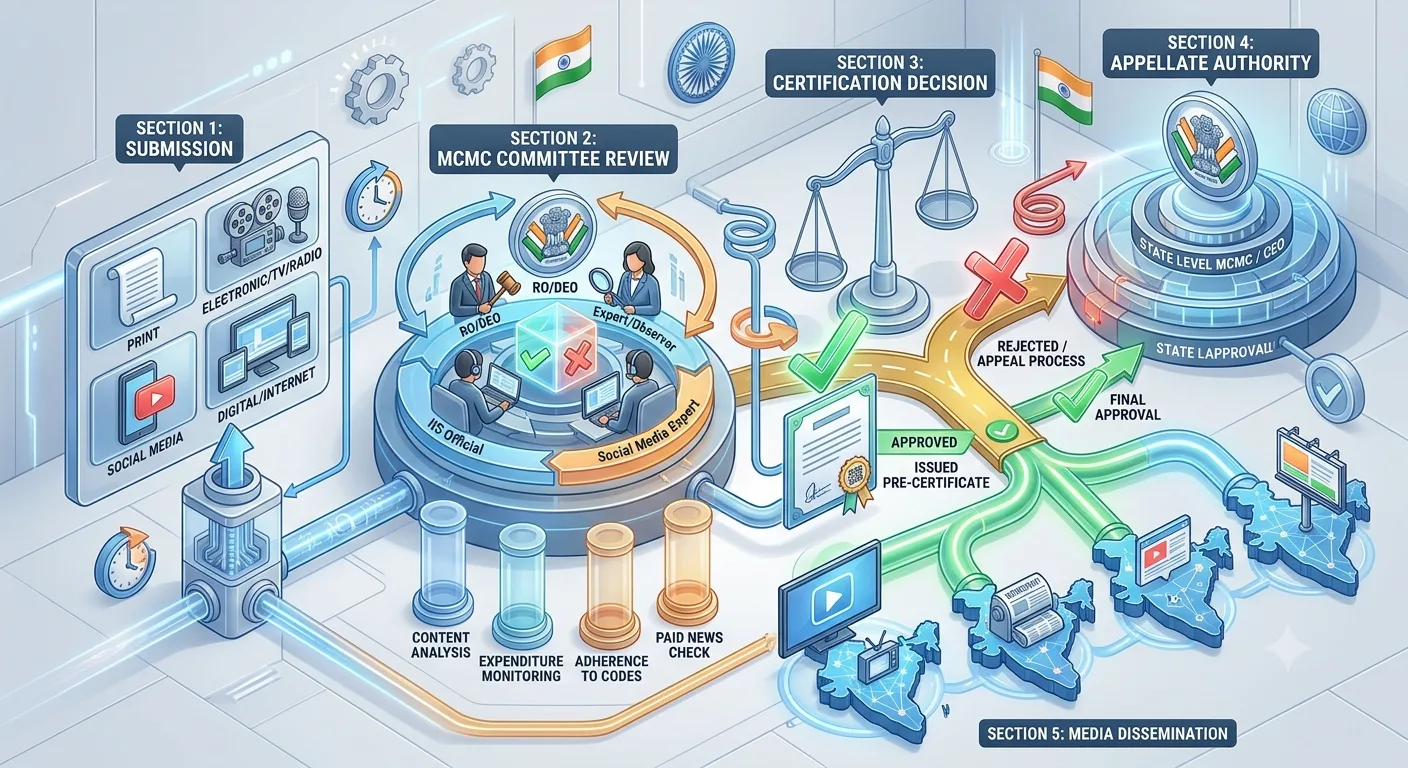
For the elections covered by its press note dated 20 March 2026, the Election Commission required pre-certification of political advertisements on electronic media, including bulk SMS and voice messages, by the Media Certification and Monitoring Committee. Whether a particular message needs certification, and how to apply, is a question for the MCMC or a qualified adviser. Our guide to MCMC pre-certification explains how to verify this. A vendor can remind you to check. It should not decide for you.
Release authorisation
Name one person who can say "send" and one who can say "stop". Write both names into the brief. This is the single cheapest control a campaign can add.
What is sensible to outsource
Sender and template setup
Registering as a sender, registering a header and submitting content templates follow a defined process. TRAI's guidance for senders lists the steps, and notes that a sender who does not complete them cannot send. A specialist who does this regularly can prepare submissions that are less likely to be returned for corrections. The final approval still sits with the telecom operators, so no vendor can promise it. Our TRAI and DLT checklist lists what to prepare.
Platform operation and delivery
Running a sending platform, handling scheduling and monitoring delivery is infrastructure work. It is rarely worth building yourself for one election cycle.
Reporting
Ask the vendor to produce per-number delivery status and a downloadable report. Then read it yourself. A report is only useful if someone on your team understands what each status means and what it cannot prove.
A worked example (hypothetical)
This is an illustrative scenario, not a real client case. A small agency is preparing neutral venue and schedule notices for a district-level event. The agency's team writes the copy, a native-language reviewer checks it, and the campaign manager confirms the facts. The agency gives its documents to a messaging provider, which prepares the sender and template submissions. After the templates are approved, the agency sends a test message to five internal phones, checks the links and approves the release. The provider sends the batch and supplies a delivery report. The agency reads the report and files it with the approvals. In this split, the provider never decides content, and the agency never builds infrastructure.
Cost and speed trade-offs
Outsourcing setup usually saves time, because the provider has done the registration steps before.
Outsourcing everything can cost more and reduces your control over what goes out.
Doing everything in-house can look cheaper on paper, but it uses scarce staff time during the busiest weeks.
Do not decide on price alone, and do not rely on a vendor's own claims about savings. Ask for a written quote against your scope and compare it with your internal staff time. For how to compare vendors once you have decided what to outsource, use the scorecard in our guide to choosing a political campaign communication service provider.
Write the split into your brief
A split only works if it is written down. Your brief should include:
The task matrix above, edited for your team.
The named release owner and pause owner on each side.
The approvals you will provide before each send.
The reports the vendor will supply, and when.
How logs and records are shared at the end.
If you are building the wider plan, our guide on building a communication plan before the campaign starts shows where this brief fits.
Mistakes to avoid
Letting the vendor write the message. The campaign should own every word.
Assuming the vendor checks approvals. Check your own, and keep the proof.
No named pause owner. Without one, corrections are slow.
Vague scope. If it is not written down, it will be argued about later.
Treating a cheap quote as the whole cost. Add your staff time and any rework.
Frequently asked questions
What are political campaign marketing services?
The term covers a range of work, from messaging platforms and channel setup to creative production and media buying. Decide which of these you need before you request quotes.
Should a campaign outsource message writing?
Usually not. The campaign answers for its content, so message writing and fact checking are best kept in-house or with a trusted team that reports to the campaign.
Can a vendor handle election approvals for me?
A vendor can remind you to check and can help you organise documents. Whether a message needs election-authority approval, and how to get it, is a decision for the campaign and its adviser.
What is the safest part to outsource?
Technical setup and delivery are usually the safest: sender registration support, platform operation and delivery reporting. These are specialist tasks and do not involve deciding what the campaign says.
How do I keep control if I outsource?
Keep release and pause authority on your side, require written approvals before each send and ask for logs and reports you can keep.
Sources checked
Election Commission of India, Press Note No. ECI/PN/038/2026 dated 20 March 2026, "Political Parties to get advertisements pre-certified by MCMC". Checked 24 October 2026.
TRAI, Advice to Senders / Telemarketers, last updated 23 October 2026 as shown on the page. Checked 24 October 2026.
TRAI, Information Note to the Press dated 8 September 2025, on the role of telecom service providers in template approval. Checked 24 October 2026.
SMSNiti, bulk SMS service page, for the platform features mentioned. Checked 24 October 2026.
Once you have your split, you can ask SMSNiti for a written quote that covers only the vendor column. Bring the matrix and the named release and pause owners, and compare the answer with your own estimate of staff time.