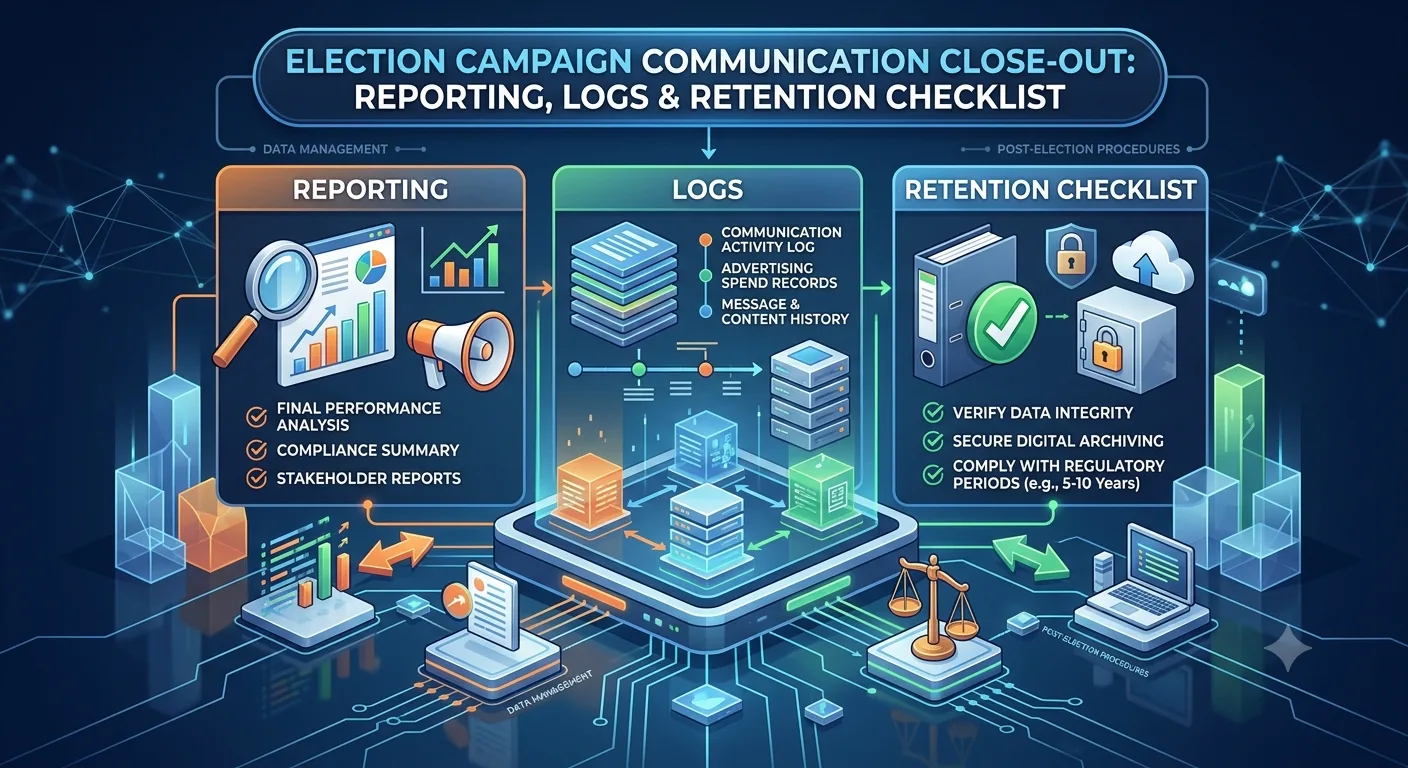
Campaign communication close-out means collecting the final reports and logs, filing approved content with its approvals, reconciling invoices to sends, recording issues and corrections, securing or deleting contact data as decided, and handing over a complete record to the campaign. Do it while the people involved still remember what happened.
When the last message has gone out, the pressure drops and records get lost. A short, disciplined campaign communication close-out turns scattered files into a record that answers questions, supports expenditure reporting and helps the next campaign. This guide gives a close-out checklist for SMS and voice work, covering reports, logs, approvals, data and handover. It belongs to our wider guide to political campaign marketing in India.
By Rupali Dahiwal. Last reviewed: 25 October 2026. This is operational guidance, not legal advice. Retention periods and reporting duties depend on your role and election, so confirm them with a qualified adviser.
Why close-out matters
A campaign that closes out well can answer three questions quickly: what did we send, who approved it and what did it cost? It can also answer a fourth: what should we do differently next time? Without close-out, people leave, accounts expire and files vanish, and the answers go with them. Close-out also protects the campaign from a quieter risk, which is keeping contact data longer than it should be held.
Step 1: Set the close-out date and owner
Decide when close-out starts, for example a fixed number of days after the last release, and name one owner. Put it in the campaign calendar from the beginning, as the final phase described in the 90-day communication calendar. Tell the provider and any agency so they keep their records available until you have collected them.
Step 2: Collect the final reports and logs
Ask the provider for the complete set of reports for every send, in the agreed format, and download them yourself where the panel allows. SMSNiti's voice service, for example, lists call reports showing who answered, how long they listened and which key they pressed, and its SMS service lists delivery status for every number. Collect:
Delivery or call reports for each send, with the provider's status definitions.
The send log: date, time, list, version and releaser.
Any export of responses, such as key presses or replies.
Panel or account activity logs, if available.
Check that the reports are complete and match the sends. Do not rely on being able to download them later, because accounts and retention settings change.
Step 3: File the approved content with its approvals
For every message type and language, file the final approved text or audio, its version number, the approval record and any election-specific certificate or application. Keep the template and sender details used. The approval workflow in our approval guide makes this step easy, because the records already exist, and close-out is just collecting them in one place.
Step 4: Reconcile invoices to sends
Match every invoice to one or more sends. Explain any difference between invoiced and reported quantities, such as retries or message parts, and file the provider's explanation. Our guide to campaign communication expenditure records lists the documents to keep, and the questions to ask about what is reportable.
Step 5: Complete the issue register
Gather every issue into one register: what happened, when, how it was found, who handled it, what was done and what changed afterwards. Include corrections, complaints, template rejections and technical faults. Where an incident record already exists, link to it. See how to pause and correct a wrong message for the incident record structure. A frank register is useful, and an empty one is usually a sign that issues were not logged.
Step 6: Decide what happens to contact data
This is the step most often skipped. For each list, decide, with your adviser:
Whether it is still needed, and for what purpose.
How long consent records and suppression lists must be kept, so opt-outs continue to be honoured.
When and how the rest will be deleted.
What the provider must delete, and how it will confirm that in writing.
Ask the provider to confirm deletion or return of your lists. See contact lists and consent records for the full data checklist.
Step 7: Close access
Remove or disable accounts for people who have left the campaign.
Change shared credentials if any exist.
Close or archive the provider account as agreed, after you have your records.
Remove access to shared folders that is no longer needed.
Step 8: Write the handover summary
A one- or two-page summary helps anyone who picks the records up later. Include:
What was sent: channels, message types, languages and dates.
Who approved what, and where the records are.
What the provider reports showed, with the definitions and limits stated.
Issues and corrections, and what changed.
Total cost and where the invoices are.
What was done with contact data.
Lessons and recommendations.
Keep the summary factual. Do not claim persuasion or turnout effects that the data cannot show. See how to measure delivery without overclaiming.
What belongs in the permanent record and what does not
Not every file needs to be kept. A useful rule is to separate the permanent record from working files:
Permanent record: final approved content by version, approval and certification records, provider reports, send logs, invoices and proof of payment, the issue register, written advice you relied on, the handover summary and records of what was done with contact data.
Working files: early drafts, superseded versions, informal chat threads, duplicate exports and test sends. Keep them only as long as they are useful, and delete them with the same care as any other data.
When you are unsure, ask what question a record would help answer. If it helps answer “what was sent, who approved it and what did it cost?”, keep it. If it does not, it is probably a working file.
Hold a short lessons-learned session
Within a few days of the last release, gather the content owner, the channel operator, the compliance contact and the finance lead for an hour. Walk through what was planned and what happened, using the records. Ask four questions: what worked and should be repeated, what went wrong and why, which step cost the most time and what would we change in the calendar, the brief or the approvals? Write the answers in the handover summary with named owners for each change.
Keep the tone factual. The point is to improve the process, not to find someone to blame. A change you agree now, such as starting template submissions earlier or adding a second language reviewer, is far more likely to happen if it is written down while the problem is fresh. Our guide to post-campaign review of SMS and voice communication describes a structured way to run this session.
A close-out checklist you can copy
Close-out date and owner set.
Reports and logs collected and checked for completeness.
Approved content and approvals filed by version.
Invoices reconciled to sends.
Issue register complete.
Data decisions made and provider deletion confirmed in writing.
Access closed.
Handover summary written and filed.
Read-only copy of the final record saved in a second location.
A hypothetical example
This is an illustration, not a real case. A small agency finishes a district-level campaign. Two weeks later, the close-out owner downloads the delivery and call reports, collects the approved versions and the approval records, ties three invoices to eleven sends and notes one difference caused by voice retries, which the provider explains in writing. The issue register lists one wrong venue detail, which was corrected within the hour. The adviser says the consent records and suppression list should be kept, and the remaining lists deleted, and the provider confirms deletion by email. The owner writes a two-page summary and saves a read-only copy. When the client asks six months later what was sent to one district, the answer takes five minutes.
Common mistakes
Letting the provider account lapse before downloading records. You may lose access.
No owner for close-out. Everyone assumes someone else did it.
Keeping every list forever. Hold only what you need.
Deleting suppression lists. Opt-outs must continue to be honoured.
Writing a summary that overclaims. State what the records support.
Leaving records in personal inboxes. File them where the campaign can find them.
Frequently asked questions
What should be in a campaign communication close-out?
Final reports and logs, approved content with approvals, reconciled invoices, an issue register, decisions on contact data, closed access and a handover summary.
When should close-out be done?
Soon after the last release, while records are fresh and the provider account is still open. Put the date in the calendar from the start.
Should I delete contact lists after the campaign?
Decide with your adviser. Keep what is needed to honour opt-outs and answer questions, and delete the rest as advised, with written confirmation from the provider.
How long should campaign records be kept?
Ask your adviser. Do not assume a universal period.
Who should write the handover summary?
The close-out owner, with input from the content owner, the channel operator and the finance lead.
Sources checked
Election Commission of India, Press Note No. ECI/PN/038/2026 dated 20 March 2026, on expenditure statements. Checked 24 October 2026.
SMSNiti bulk SMS service and bulk voice call service pages, for the report fields described. Checked 25 October 2026.
When you plan the end of a campaign, ask SMSNiti about bulk voice calls how long call reports stay available and how lists are deleted, and get the answer in writing.