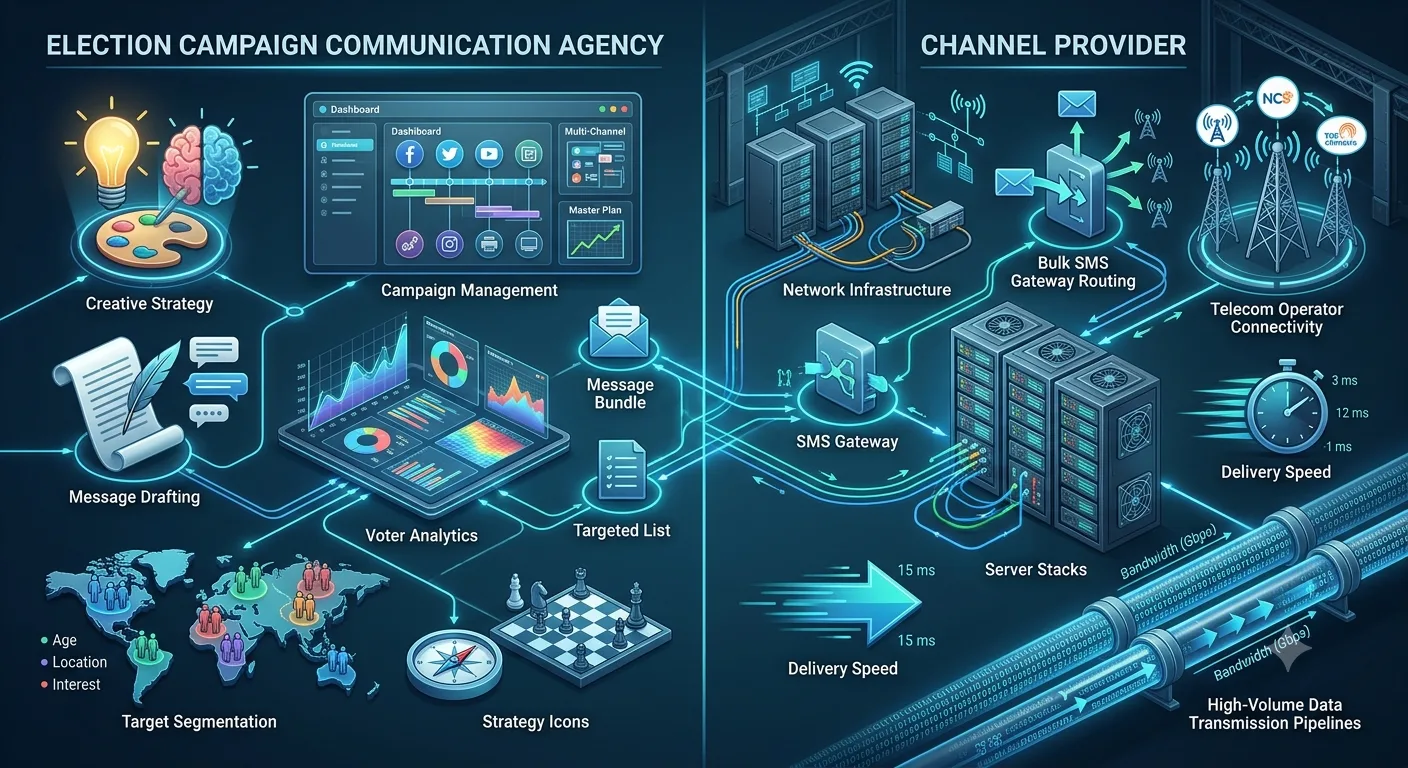
A campaign agency plans, creates and manages communication on a campaign's behalf, while a channel provider supplies the sending infrastructure, such as SMS and voice, along with sender setup and delivery reports. Most campaigns need a clear split between the two, with content, approvals and audience decisions staying with the campaign or its agency.
Teams often search for a "political campaign agency" when what they need is a way to send messages, or the reverse. Mixing up the two leads to wrong quotes and wrong expectations. This guide explains the difference between a campaign agency and a communication channel provider, what each should and should not be asked to do, and how to decide which you need. It belongs to our wider guide to political campaign marketing in India, and it sits between what to outsource and what to keep in-house and the provider selection scorecard.
By Rupali Dahiwal. Last reviewed: 25 October 2026. This is operational guidance, not legal advice. It describes categories of supplier in general terms. It does not rank any business.
The five kinds of supplier people mix up
The word "agency" covers very different businesses. Separate them first:
Political consultants. They advise on strategy, positioning and research. Their product is judgement. They usually do not run sending infrastructure.
Full-service campaign agencies. They coordinate several activities for a campaign: planning, creative work, events, media and communication. They often subcontract the technical parts.
Creative and production studios. They write, design, record and edit content. They do not necessarily send it.
Media buyers. They purchase advertising space or time. Political advertising on electronic media may need election-specific approval before it is published.
Channel providers. They supply the infrastructure to send messages and calls, help with sender and template registration and give delivery reports. SMSNiti's service pages, for example, describe bulk SMS and bulk voice services with DLT registration help, template support and delivery or call reports. They describe a sending service, and do not describe political strategy, field operations or media buying.
Some businesses offer more than one of these. The question is not the label, but which of these jobs each business will actually do for you, and who is accountable for each.
What a channel provider does
Supplies a platform to send SMS or voice at volume, through a panel or an API.
Helps with sender, header and template registration. Telecom service providers decide whether templates are approved, so a provider can help prepare, but cannot promise approval.
Schedules sends and retries, within the rules for the message or call type.
Produces delivery or call reports with defined statuses.
Offers support and an escalation route.
What a channel provider does not do
It does not decide what your campaign says.
It does not verify your facts.
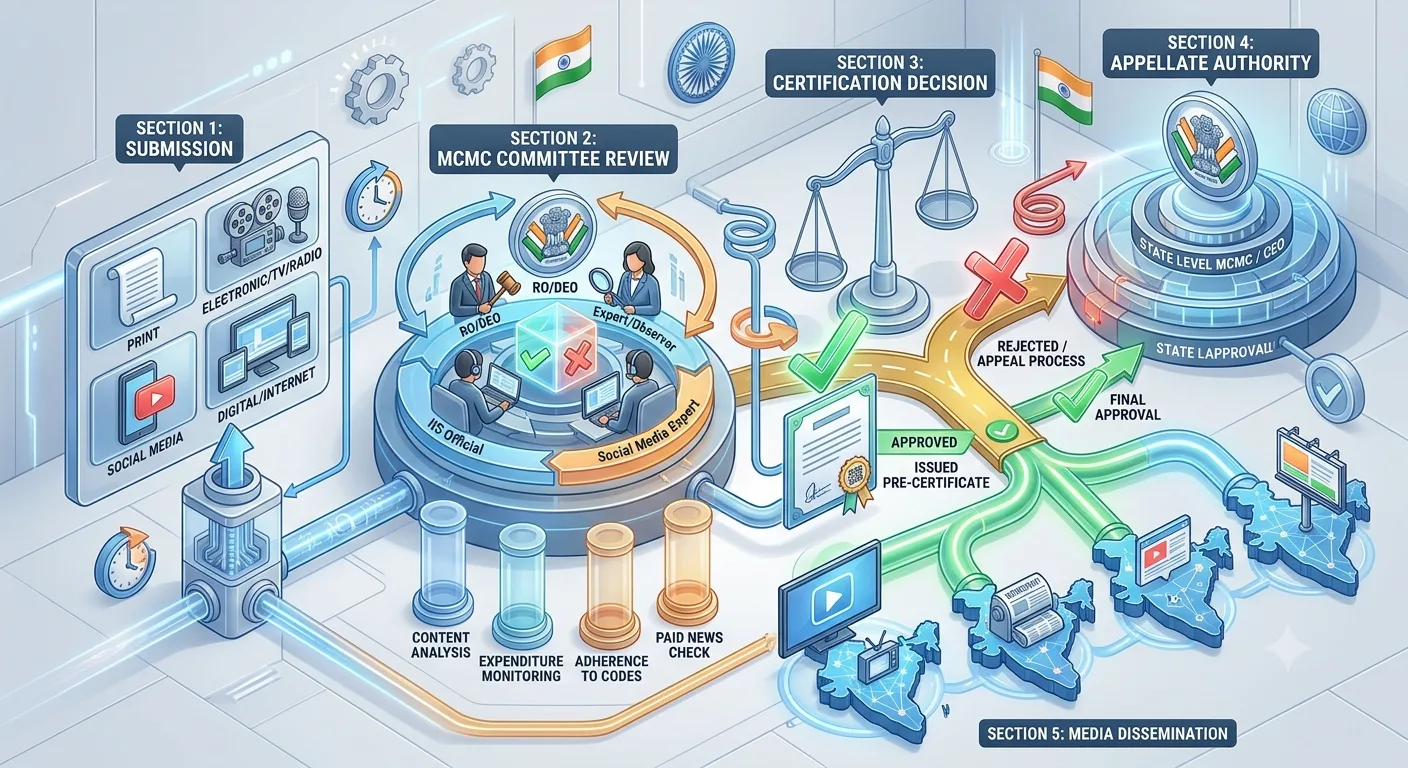
It does not grant election-specific approval. For the elections covered by its press note of 20 March 2026, the Election Commission required political advertisements on electronic media, including bulk SMS and voice messages, to be pre-certified by the Media Certification and Monitoring Committee, and the applicant is the party, group or candidate.
It does not guarantee reach or impact.
It does not replace your compliance adviser.
What a campaign agency does
Turns your objectives into a communication plan and calendar.
Organises content creation, translation and review.
Manages approvals and records on your behalf, if you agree.
Coordinates channels, and often chooses and manages the channel provider.
Reports back to you.
What an agency should not be asked to do
To hide who is accountable. The campaign remains responsible for its content and approvals.
To guarantee outcomes such as reach, turnout or votes.
To use contact lists whose source cannot be shown.
To bypass approvals to meet a deadline.
How to decide which you need
You need a channel provider if
You already have content, approvals and a plan, and need a reliable way to send and report.
Your team can run the process in-house and wants control over every step.
You want to compare quotes on sending cost, setup and support.
You need an agency if
You lack the staff to plan, produce, review and coordinate multi-channel communication.
You need creative production and translation as part of one engagement.
You want one team managing approvals, versions and reporting.
You may need both if
An agency runs the plan and the provider supplies the sending infrastructure. This is common and workable, provided the roles are written down.
Questions to put to any supplier
Which parts of my brief will you deliver yourselves, and which will you subcontract?
Who is accountable for approvals, and what records will you keep?
What do you need from me, and by when?
What will you not do?
How do you handle content that may need election-specific approval?
How quickly can a send be paused, and who do I call?
What reports will I receive, with what definitions?
How do you handle my data, and what happens to it at the end?
What is excluded from your quote?
Our communication brief checklist turns these into a document you can send to every supplier.
Contract points that avoid later arguments
Scope. List what is included and excluded in plain terms.
Roles. Name who approves content, who releases sends and who can pause.
Subcontractors. Require disclosure of anyone who will handle your data or messages.
Data. State who may access lists, where they are stored, how long they are kept and how they are deleted.
Records. Agree which logs and reports will be handed over, and when.
Commercial terms. Payment, price validity, change requests and exit.
Red flags
A supplier that claims to do everything and cannot show who does each part.
Guaranteed delivery percentages or political outcomes.
A promise that approvals will be "handled" without showing how.
Offers to sell or supply contact lists.
A refusal to answer in writing.
Pressure to commit before you can compare.
Governance when you use both
When an agency and a channel provider both work on a campaign, the biggest risk is a gap between them. Each assumes the other has checked something. Close the gap with a simple operating agreement that all three parties, the campaign, the agency and the provider, can read:
One owner for each approval. Name who checks facts, who reviews language, who checks election-specific approval and who authorises release. The provider should send only what the release approver has authorised.
One channel for instructions. Decide where send instructions are given and recorded, so there is no dispute about who asked for what.
One version store. The agency keeps the approved versions and the provider receives only those, by version number.
One pause route. The pause owner can reach the provider’s urgent contact directly, without passing through the agency.
One set of records. The campaign receives copies of reports, logs and invoices from both, not only a summary from the agency.
This agreement does not need to be long. A page that answers these five points removes most of the confusion that appears when something goes wrong on a busy day. Review it at the start of the campaign and whenever a role changes.
A hypothetical example
This is an illustration, not a real case. A state-level campaign has a small in-house team that writes and approves its own notices but has no sending setup. It decides it needs a channel provider, not an agency. It writes a brief, asks three providers the questions above and compares the written answers with a scorecard. A second, larger campaign has no in-house communication team. It hires an agency to plan, produce and review content, and the agency, in turn, chooses a channel provider, with the campaign approving the choice. In both cases, the roles are written down, and the campaign keeps the release and pause authority.
Common mistakes
Hiring an agency when you need a sending tool. You pay for planning you do not need.
Hiring a channel provider and expecting strategy. It is not what the service is.
Not knowing who subcontracts what. Accountability gets blurred.
Handing over approvals completely. The campaign stays responsible.
Comparing only on price. Scope differs between suppliers.
No written split of roles. Arguments follow the first error.
Frequently asked questions
What is the difference between a campaign agency and a channel provider?
An agency plans, creates and coordinates communication. A channel provider supplies the infrastructure to send messages or calls, with sender setup and delivery reports.
Can one company be both?
Some offer both. Ask which parts they deliver themselves and which they subcontract.
Does a channel provider handle election approvals?
No. A provider can remind you to check, but the applicant for election-specific approval is the party, group or candidate, and telecom service providers decide template approval.
Which one should a small campaign hire?
If you have content and approvals ready, a channel provider may be enough. If you need planning, production and coordination, consider an agency, and write down the roles either way.
How do I compare quotes from an agency and a provider?
Do not compare them directly. Compare like with like by listing what each includes and excludes against the same brief.
Sources checked
Election Commission of India, Press Note No. ECI/PN/038/2026 dated 20 March 2026. Checked 24 October 2026.
TRAI, Information Note to the Press dated 8 September 2025, on the role of telecom service providers in template approval. Checked 24 October 2026.
SMSNiti bulk SMS service and bulk voice call service pages, for the description of a channel provider's services. Checked 25 October 2026.
If a channel provider is what you need, ask SMSNiti about bulk SMS for a written quote against your brief and compare it with other suppliers on the same terms.