
A political campaign communication brief should state the purpose of each communication, the audience basis, channels, languages, approval owners, election-specific approval status, schedule, reporting, data handling, stop controls and records. One page is enough if every line has an owner and an answer.
Vendors and agencies can only deliver what they are asked for, and many problems in campaign communication trace back to a vague request. A clear political campaign communication brief turns a loose idea into something a provider can quote, a reviewer can check and a team can run. This guide sets out what the brief must contain, explains each line and gives a copyable structure. It belongs to our wider guide to political campaign marketing in India.
By Rupali Dahiwal. Last reviewed: 25 October 2026. This is operational guidance, not legal advice. The brief covers communication operations. It does not contain persuasion strategy.
What the brief is for
The brief has three jobs. It lets a provider quote accurately. It lets your own team agree who does what before the busy period. And it creates a record of what you asked for and what was approved, which matters if a question arises later.
Write it before you request quotes. If you are still deciding what to buy, read our guide on what to outsource and what to keep in-house first, and use the provider scorecard to compare responses.
The brief, section by section
1. Purpose and scope
State in a few sentences what the communication is for. Name the types of message you expect, such as venue and time notices, published-schedule pointers, helpline details and corrections. State what is out of scope. If the work covers more than one election or state, say which.
2. Audience and permission basis
Describe the audience in operational terms, for example registered event attendees in a district. State where each list came from and what permission exists for this use. Say how opt-outs are recorded and applied. Do not describe audiences using religion, caste or inferred political views. Our guide to contact lists and consent records gives a fuller data checklist.
3. Channels and message types
List the channels, which in this series are SMS and voice. For each, say what the message or call is for. If you plan to use both for the same item, say which is primary. See SMS vs voice calls for election campaigns for how to choose.
4. Languages and scripts
List each language and script, and name the reviewer for each. State who owns the source copy and how translations are checked. Say whether voice recordings are needed and who produces them.
5. Roles and approvals
Name a person, not a team, for each role: content owner, fact checker, compliance contact, channel operator, release approver and pause owner. State the approval order. Say what record is kept for each approval.
6. Election-specific approval status
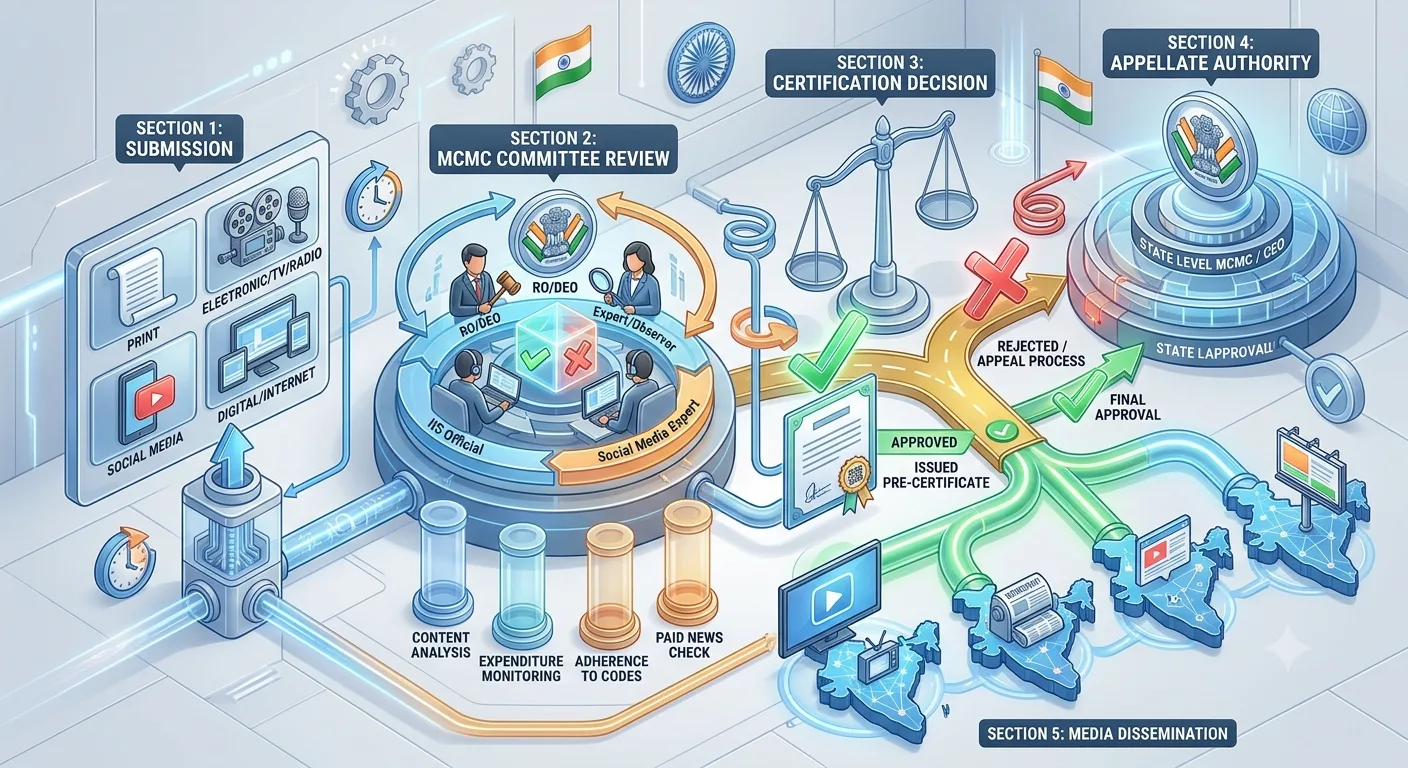
State whether any item may count as a political advertisement and who will find out. For the elections covered by its press note of 20 March 2026, the Election Commission required political advertisements on electronic media, including bulk SMS and voice messages, to be pre-certified by the Media Certification and Monitoring Committee. The brief should say which orders apply to your election, who is applying for any certification, the deadline and where the certificate will be stored. See MCMC pre-certification.
7. Telecom setup
State who registers the sender, header and templates, and who supplies the documents. TRAI's guidance for senders lists these steps, and telecom service providers approve or reject templates. The brief should say how much time you have allowed for resubmissions. See TRAI and DLT setup for election-related SMS.
8. Schedule and restricted periods
Give the planned sending windows, in relative terms until official dates are published. List the restricted periods you must respect, each taken from an official order, and the person who will keep this list current.
9. Testing
Say what tests are required before release: test sends on several handsets, test calls, link checks and a rehearsal of the pause. Name who verifies and who signs off.
10. Reporting
List the reports you need, their format and when you need them. Ask for definitions of every status in the report. State that reports will be read as delivery information, not as proof of persuasion.
11. Data handling and security
Say who can access lists, how files are shared, how long data is kept and how it is deleted. State what the provider may and may not do with your data.
12. Stop and correction controls
Name the pause owner and the contact route. Describe how a correction is approved and sent. See how campaign teams should pause and correct a wrong message.
13. Commercial terms
Ask for a written quote with inclusions and exclusions, payment terms, validity and any minimum commitment. See what determines the budget.
14. Records and exit
State which records the provider will supply at the end: logs, reports and invoices. Say what happens to your data and files when the contract ends.
A brief template you can copy
Campaign, election and period.
Purpose and message types. Out of scope.
Audience, list sources, permission basis, opt-out handling.
Channels and what each is for.
Languages, scripts and reviewers.
Named roles and approval order.
Election orders relied on and certification status.
Telecom setup owner and documents.
Schedule and restricted periods, with the keeper of the list.
Test plan and sign-off.
Reports and definitions.
Data access, retention and deletion.
Pause owner, escalation route and correction process.
Commercial terms.
Records handed over at close-out.
A short hypothetical example
This is an illustration, not a real client case. An agency preparing notices for a district event writes a one-page brief. The purpose is to tell registered attendees about venue and time changes and give a helpline. The channels are SMS for details and one recorded voice reminder. The audience is attendees who registered through the event form and agreed to receive updates. Messages are in two languages, each with a named native-speaker reviewer. The brief records that the content owner approves wording, the compliance contact checks whether certification applies and a named person can pause any send. It asks the provider for per-number delivery reports and a quote that lists inclusions and exclusions. Because every line has an owner and an answer, the provider can quote accurately, and the team knows what happens when a venue changes at short notice.
What a good brief avoids
Vague audiences. "Everyone in the state" is not a permission basis.
Persuasion content. The brief covers operations, not what to say to change minds.
Assumed approvals. If certification may apply, the brief says who is finding out.
Unnamed owners. "The team" cannot be called at midnight.
Open-ended scope. Without limits, quotes cannot be compared.
Promised results. The brief should not ask a vendor to guarantee reach or impact.
How to use the brief once it is written
Share the same brief with every provider you are considering, and compare answers line by line. Keep a version number and date on it, and record changes. When something changes, such as a venue, a language or an approval status, update the brief first, then the work. After the campaign, use the brief as the checklist for close-out: for each line, confirm that what was done matches what was asked, and file the evidence.
The brief also helps new people join quickly. Someone who takes over mid-campaign can read one page and know the scope, the owners and the stop route. That alone can prevent an avoidable error during a handover.
Brief, approval pack and run sheet: three different documents
Teams sometimes try to make one document do everything. It works better to keep three. The brief says what you are doing and who owns what. The approval pack holds the final wording or audio of each message, with the version number and the record of who approved it. The run sheet is the day-of-send checklist: which version goes to which list, at what time, released by whom, with the pause owner’s contact.
Keeping them apart avoids a common failure, in which someone edits a message inside the brief and nobody realises the approved copy has changed. The brief points to the approval pack by version number. The run sheet points to both. If a version changes, the approval pack is updated first, then the run sheet, and the brief only changes if the scope has changed.
Frequently asked questions
How long should a campaign communication brief be?
One to two pages is enough if each section has a clear answer. Longer briefs tend to hide the decisions that matter.
Who should write the brief?
The campaign or agency lead, with input from the content owner, the compliance contact and the channel operator.
Should the brief include the actual messages?
It should list the message types and attach approved copy separately. Keep the approved copy under version control and link each version to its approval record.
Does a brief replace a contract?
No. It supports the contract by making the scope clear. Commercial and legal terms belong in the agreement.
What if the election dates are not announced yet?
Write the schedule in relative terms and mark dates as pending. Update the brief when the official schedule is published.
Sources checked
Election Commission of India, Press Note No. ECI/PN/038/2026 dated 20 March 2026. Checked 24 October 2026.
TRAI, Advice to Senders / Telemarketers, last updated 23 October 2026 as shown on the page. Checked 24 October 2026.
When your brief is ready, you can ask SMSNiti about bulk SMS for a written quote against it, and compare the reply with any other provider's.