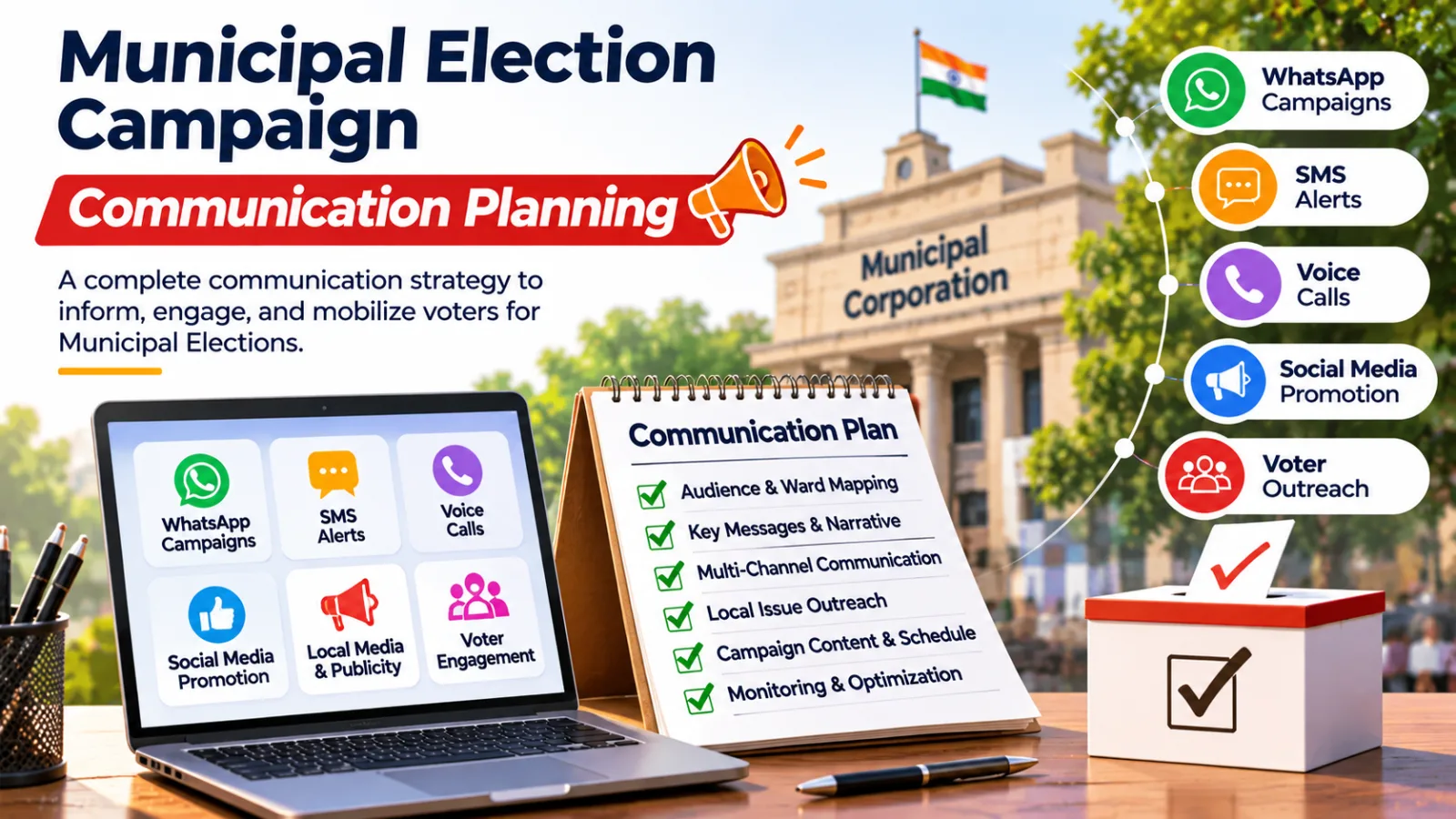
The same plan works for a municipal or local body election, with one big change: the schedule and the code of conduct come from your State Election Commission, not from the Election Commission of India. The approvals, the lists, DLT and consent stay as they are. This guide sets out what carries over and what you must check for your own state.
It sits inside our wider guide to political campaign marketing in India and is written for candidates, party offices and campaign staff planning communication for a corporation, council or similar body.
By Rupali Dahiwal. Last updated: 7 November 2026. This is operational guidance, not legal advice.
If you want the service side in one place, start with our location-based election campaign messaging page.
Who runs a local body election?
Elections to municipalities and panchayats are conducted by the State Election Commission of each state, under Articles 243K and 243ZA of the Constitution. That is a separate body from the Election Commission of India. It publishes its own notices, its own schedule and its own model code of conduct, and the details can differ from one state to the next. We do not list state rules here, because they are not the same everywhere and we would be guessing for your state.
What stays the same?
A lot. Every message still has to be approved before it goes out, so check with your State Election Commission whether it requires pre-certification of political advertisements and how to apply. Bulk SMS still needs DLT registration, an approved header and approved templates, as set out in our guide to TRAI and DLT for election SMS. Voice clips still need approval from the operator. Contact lists still need consent, and numbers on DND are still much less likely to receive an SMS or a voice call.
The working habits carry over too. A written communication brief, one approval route and a named person who can pause every channel are as useful for a ward election as for an assembly one.
What must you check for your state?
Which commission conducts the election, and where it publishes notices.
The dates and phases in its schedule, and the start of the silence period.
Whether it requires approval of political advertisements, and by whom.
Any limits it sets on spending, and the records it expects. Our expenditure records checklist shows what to keep.
The languages used in your ward or town, and who will review the messages.
Write the answers down with the date you checked and the page you read. If a notice is unclear, ask the commission's office. Do not rely on forwarded messages.
How is a local campaign different in practice?
The area is smaller, so the list is smaller and the cost per message matters less than the accuracy of the list. A ward campaign works best when the numbers are for that ward, and the message names the ward, the venue and the time. Our guide to location-based election messaging by ward and pin code explains how area lists are built and what consent they need.
Timelines are often short. If approval of a template or a voice clip takes time, a short campaign leaves little room to recover, so submit early. We can ask the operator to speed up an approval, but we do not control it. Credits are added after our finance team confirms payment, usually within about an hour, so buy the volume before the campaign and not on the day.
How should you handle languages?
Local body elections are often fought in the language people speak at home, which may differ from the one used in an assembly campaign. Decide the language for each ward before you write the messages, and ask a reviewer who reads and speaks it to check every SMS template and voice script before you submit it. Once an SMS template is approved on DLT, or a WhatsApp template is approved by Meta, our system sends it as it is, and a voice clip is checked by the operator's team, not for your language. Our guide to reviewing multilingual campaign messages shows what to check.
What should you do before the notice comes?
Prepare what does not depend on dates. Build and clean the ward lists. Draft the message and the voice script. Register the sender on DLT. Agree who approves what. Then, when the commission publishes its schedule, you only have to fill in the dates. Our 90-day communication calendar is written in relative time, so it still works if your schedule is shorter.
Frequently asked questions
Does the Election Commission of India run municipal elections?
No. Municipal and panchayat elections are conducted by the State Election Commission of each state.
Do the pre-certification and silence-period rules apply to local elections?
That depends on the orders of your State Election Commission. Read its notices for the election, and ask its office if they are unclear.
Can I use SMS, voice and WhatsApp for a ward election?
Yes, with the approvals, the DLT setup and the consent that apply to any campaign. Smsniti provides bulk SMS, bulk voice calls and a bulk WhatsApp marketing service, where WhatsApp allows it in your country.
Where do I get the schedule?
From your State Election Commission's own website and notices. Check it on the day you plan to publish dates anywhere.
Sources checked
Constitution of India, Articles 243K and 243ZA, on elections to panchayats and municipalities. Checked 7 November 2026.
Election Commission of India, Press Note No. ECI/PN/038/2026 dated 20 March 2026. Checked 7 November 2026.
Want to talk it through? Our election campaign SMS service page lists the channels we run and how to get in touch.
About the author: Rupali Dahiwal is the founder of Smsniti and has around 8 to 10 years of experience in telecommunications. Rupali Dahiwal on LinkedIn.